Triads Explained: Major, Minor, Diminished and Augmented Chords
Published November 12, 2026
A triad is a chord with three pitch classes that can be arranged as a root, a third and a fifth. In close root position, those notes stack as two thirds. C–E–G is a C-major triad, even when you spread its notes across octaves or repeat one of them.
The four common tertian triad qualities are major, minor, diminished and augmented. Their thirds and fifths have different sizes. Start with the same root, C, so you can hear each change without also changing the root note.
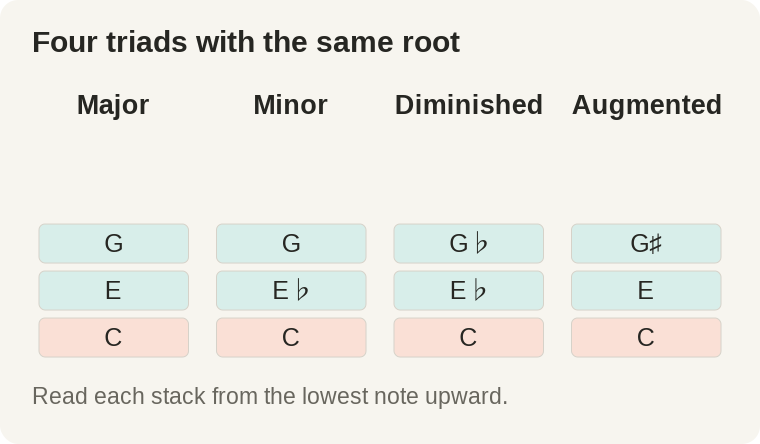
The third and fifth determine which of these four triad qualities you hear.
Identify the chord members
The root gives the chord its letter name. The third and fifth name the other members relative to that root. In C major, those members are C, E and G. The third is E wherever you place it in the voicing; it need not be the literal middle sound.
An interval describes a distance between pitches. A major third spans four piano semitones and a minor third spans three. Open Music Theory's triad lesson relates those intervals to chord quality and symbols.
Build the four qualities
| Quality | Thirds in close root position | Notes above C | Common symbol |
|---|---|---|---|
| Major | 4 + 3 semitones | C–E–G | C |
| Minor | 3 + 4 semitones | C–E♭–G | Cm |
| Diminished | 3 + 3 semitones | C–E♭–G♭ | Cdim or C° |
| Augmented | 4 + 4 semitones | C–E–G♯ | Caug or C+ |
Major and minor triads have a perfect fifth above the root: seven semitones. Diminished lowers that fifth to six semitones; augmented raises it to eight. The illustration stacks the spelled notes from low to high so you can compare the members directly.
Take C major and lower E to E♭ to make C minor. From C minor, lower G to G♭ to make C diminished. Return to C major and raise G to G♯ to make C augmented. These are controlled changes you can play one at a time.
Distinguish a chord name from a scale degree
C major names a chord regardless of the surrounding key. In the key of C major it is the I chord; in F major it is the V chord. Roman numerals describe a relationship to a key, while the letter name identifies the chord's root.
Building triads from successive notes of the major scale gives a pattern of major, minor and diminished qualities. Ableton's diatonic-triad lesson shows that pattern. An augmented triad can arise in other collections, including the third-degree triad C–E–G♯ in A harmonic minor. Its G♯ comes from the raised seventh scale degree of A harmonic minor.
Keep the identity when you rearrange notes
C3–E3–G3 is a close root-position voicing. E3–G3–C4 puts E in the bass, making first inversion. C3–G3–E4 spreads the same pitch classes into an open voicing while keeping C in the bass. Read inversions and voicings for those separate choices.
A three-note chord such as C–D–G does not stack as the root, third and fifth of one of these four triad qualities. It can be called Csus2, a suspended chord. Naming conventions vary, but keeping the tertian definition clear helps you understand the four types above.
Compare the four triads in Soundroo
Use the Soundroo prompt or connect your chat app. Ask for four bars of piano in 4/4, one bar each of C, Cm, Cdim and Caug, then repeat the sequence. Keep C as the lowest note, use a similar register and play the chords with the same rhythm. Listen to which pitch changes between versions. When you want to extend the chords, add the extra chord member introduced in seventh chords.