Music Intervals for Beginners: Count the Distance Between Notes
Published November 12, 2026
An interval is the pitch distance between two notes. Its name combines a number, such as third or fifth, with a quality, such as major, minor or perfect. C up to E is a major third; C up to G is a perfect fifth.
You can play an interval one note after another as a melodic interval, or sound both notes together as a harmonic interval. A melody can move upward or downward. The letter names and the pitch distance help identify the relationship in either direction.
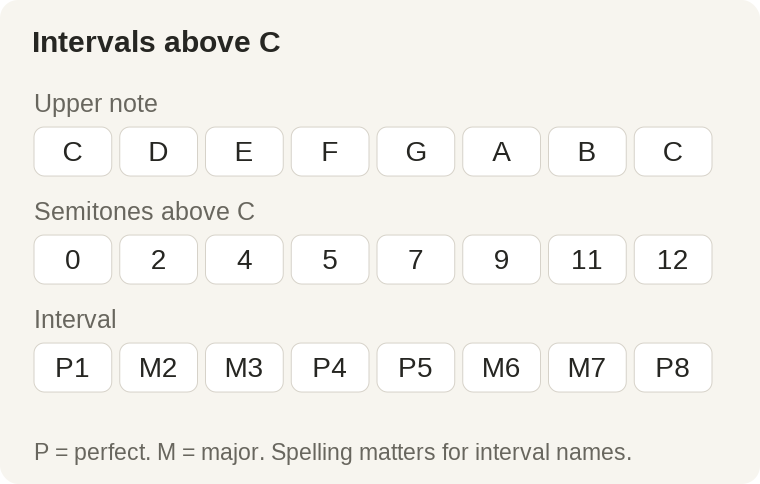
Count letter names for the interval number and semitones for its quality.
Count letters for the number
For C up to E, count C as 1, D as 2 and E as 3. The interval is some kind of third. C up to F spans four letter names, so it is a fourth. C4 up to C5 spans an octave, also called an eighth.
Sharps and flats alter pitch but do not replace the letter name. C to E♭ is still a third, while C to D♯ is a second. On a piano, E♭ and D♯ can be the same sounding key, but their written relationships to C differ.
Open Music Theory's interval lesson explains how number and quality combine. Count the spelled letters as well as the keys when you write your answer.
Count semitones for the size
On a modern piano, adjacent keys are one semitone apart. Two semitones make a whole step, and twelve make an octave. This piano-key description does not mean music can never use smaller pitch differences; it describes the familiar twelve-tone keyboard system.
Here are common ascending intervals from C4:
| Upper note | Semitones above C4 | Interval |
|---|---|---|
| C4 | 0 | Perfect unison |
| D4 | 2 | Major second |
| E4 | 4 | Major third |
| F4 | 5 | Perfect fourth |
| G4 | 7 | Perfect fifth |
| A4 | 9 | Major sixth |
| B4 | 11 | Major seventh |
| C5 | 12 | Perfect octave |
The illustration shows the same reference set. Lower E4 to E♭4 and the third becomes minor: three semitones instead of four. Lower B4 to B♭4 and the seventh becomes minor: ten semitones instead of eleven.
Distinguish the quality families
Seconds, thirds, sixths and sevenths have common major and minor forms. Unisons, fourths, fifths and octaves have common perfect forms. Intervals can also be augmented or diminished; the family names do not prevent those alterations.
An augmented interval is a semitone wider than its major or perfect form. A diminished interval is a semitone narrower than its minor or perfect form. C–F♯ is an augmented fourth, while C–G♭ is a diminished fifth. Both span six piano semitones, a tritone, but the letter count explains the different names.
Direction and octave placement matter
E4 descending to C4 is a descending major third. C4 ascending to E4 is an ascending major third. State the direction when describing a melodic movement so a player knows which way to go.
An interval larger than an octave is compound: C4 to D5 is a major ninth, or a major second plus an octave. C4 to E5 is a major tenth. Moving a note by an octave changes the interval's register and number even when the pitch-class names remain familiar.
For a simple interval within an octave, moving the lower note up an octave can invert it. C4–E4 becomes E4–C5: a major third becomes a minor sixth. This interval inversion is related vocabulary, but it is different from labeling a whole chord inversion.
Practice two notes at a time
Use the Soundroo prompt or connect your chat app. Ask for piano pairs C4–E4, C4–E♭4 and C4–G4, first in sequence and then together. Keep the note strengths and instrument fixed. Ask the agent to label the written intervals, then compare the previews. Those distances are the building blocks of triads, while melody writing combines them with rhythm and phrasing.