Seventh Chords for Beginners: Major 7, Minor 7 and Dominant 7
Published November 12, 2026
A seventh chord extends a triad with a note a seventh above its root. C–E–G is a C-major triad; adding B gives Cmaj7. The seventh adds another pitch relationship, which can change how the chord connects to the music around it.
Start with three common qualities: major seventh, dominant seventh and minor seventh. Cmaj7 is C–E–G–B, C7 is C–E–G–B♭, and Cm7 is C–E♭–G–B♭. The illustration keeps the root fixed so the changed third and seventh are easy to identify.
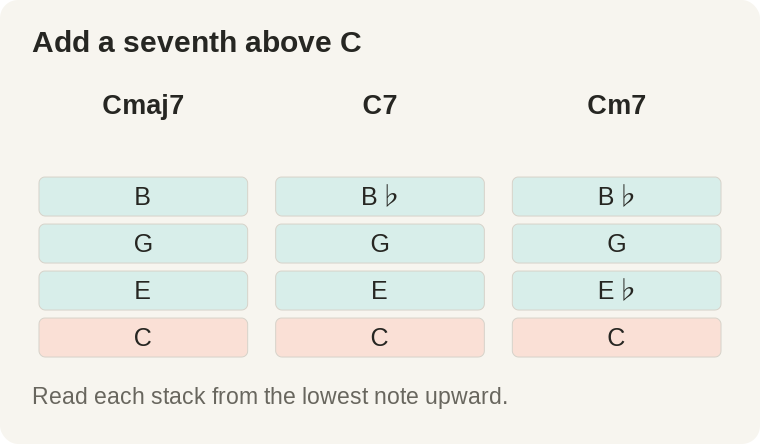
A major-seventh chord and a dominant-seventh chord differ in the seventh above the root.
Read the formula relative to the root's major scale
The formula 1–3–5–7 refers to degrees of the major scale starting on the chord root. A flat before a degree lowers that degree by a semitone. C major supplies C, E, G and B for degrees 1, 3, 5 and 7.
| Chord | Formula | Notes |
|---|---|---|
| Cmaj7 | 1–3–5–7 | C–E–G–B |
| C7 | 1–3–5–♭7 | C–E–G–B♭ |
| Cm7 | 1–♭3–5–♭7 | C–E♭–G–B♭ |
These formulas describe chord quality from a reference scale. They do not mean all three C-root chords belong diatonically to the key of C major. Triads provide the three-note starting structures.
Major seventh: a major triad plus a major seventh
Cmaj7 combines C major with B, eleven semitones above C. B is one semitone below the C an octave above the root. You may see symbols such as Cmaj7, CM7 or CΔ7.
In the C-major scale, stacking thirds on the first and fourth degrees gives Cmaj7 and Fmaj7. Ableton's seventh-chord lesson shows how adding the seventh extends the triad and how those chords can be inverted.
Dominant seventh: a major triad plus a minor seventh
C7 uses B♭, ten semitones above C, with the major triad C–E–G. Its symbol is C7, without “maj.” That distinction matters: C7 and Cmaj7 have different sevenths.
The word dominant can describe harmonic function, but “dominant seventh” also names this chord quality. In C major, the diatonic V7 chord is G7: G–B–D–F. It can lead back to C. C7 can function as V7 in F major, or appear in other roles, including a tonic-quality blues chord. Its symbol alone does not dictate one resolution in every style.
In A minor, E7 contains E–G♯–B–D. The G♯ is the raised seventh degree of A minor and can support movement toward A. The minor-key progression guide develops that example.
Minor seventh: a minor triad plus a minor seventh
Cm7 has E♭ as its third and B♭ as its seventh. Symbols such as Cm7, Cmin7 and C–7 can describe the same quality. In C major, the diatonic minor-seventh chords are Dm7, Em7 and Am7.
There are other seventh-chord qualities too, including half-diminished, diminished and minor-major seventh. These three starting types give you a useful comparison without covering the entire family at once. Players can omit or double chord tones in a voicing while retaining the chord's identity.
Hear the qualities and their context
Use the Soundroo prompt or connect your chat app. Ask for piano chords C, Cmaj7, C7 and Cm7, one bar each in 4/4, repeated four times. Keep the register and rhythm fixed. First hear what the extra seventh adds, then compare B with B♭.
Next try Dm7–G7–Cmaj7. The notes are D–F–A–C, G–B–D–F and C–E–G–B. That is ii7–V7–Imaj7 in C major. Ask for one version with close root-position chords and another using inversions to reduce movement between parts.