The Major Scale: Whole Steps, Half Steps and Seven Notes
Published November 12, 2026
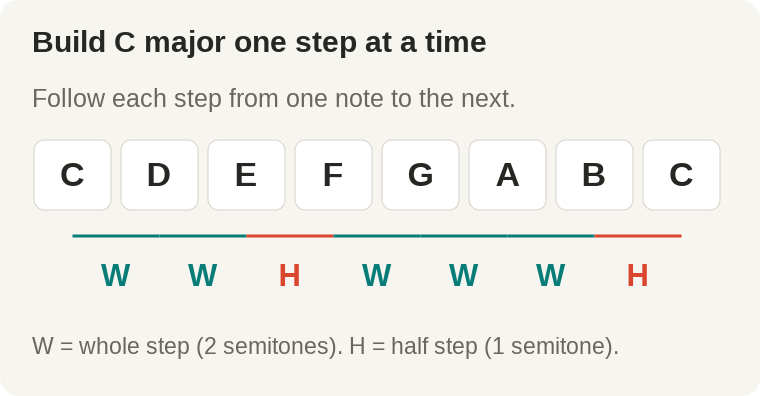
A major scale contains seven different pitch classes arranged in the step pattern whole, whole, half, whole, whole, whole, half. The final half step returns to the tonic an octave higher. In C major, the notes are C–D–E–F–G–A–B–C.
The pattern defines the scale, not the color of the piano keys. C major uses white keys, while other major scales need sharps or flats to preserve the same distances. The illustration connects each pair of C-major notes to its whole or half step.
Apply the same step pattern from another starting pitch to build another major scale.
Find whole and half steps
On a modern piano, a half step, or semitone, moves between adjacent keys, including black keys. E to F and B to C are half steps even though both notes are white keys. C to C♯ is another half step.
A whole step contains two semitones. C to D is a whole step because C♯ sits between them. The same is true of D to E and F to G. Do not assume every pair of neighboring white keys is a whole step: the E–F and B–C gaps are the important exceptions.
Ableton's major-scale construction lesson shows how the step pattern stays fixed when the tonic changes.
Build C major one step at a time
Start on C. Move a whole step to D, another whole step to E, then a half step to F. Continue whole steps to G, A and B, then a final half step to C. The seven gaps contain twelve semitones in total: 2 + 2 + 1 + 2 + 2 + 2 + 1.
There are seven different note names before the upper C repeats the tonic. You may see that upper tonic called degree 1 in a new octave or labeled 8 in an ascending scale exercise; it is not an eighth new pitch class.
Try a different tonic
To build G major, follow the same pattern from G:
| Move | Distance |
|---|---|
| G → A | Whole |
| A → B | Whole |
| B → C | Half |
| C → D | Whole |
| D → E | Whole |
| E → F♯ | Whole |
| F♯ → G | Half |
F♯ is needed to keep the final whole-step/half-step pair in place. Using F natural would give a different scale pattern. F major instead uses F–G–A–B♭–C–D–E–F.
Give each degree its own letter
In standard major-scale spelling, use the letter names in sequence, once each before repeating the tonic. G major uses F♯ rather than G♭, even though those pitches share a piano key. That keeps the F and G degrees distinct in writing. The interval guide explains why spelling matters.
Scale-degree numbers describe a note's place relative to the tonic. In C major, E is degree 3 and G is degree 5. In G major, B is degree 3 and D is degree 5. These numbers let you move an idea to another key without memorizing it as unrelated letter names.
Use the scale as a starting collection
A major-key melody need not march up and down the whole scale, and it can include notes outside that collection. The scale provides a useful starting map. A key adds tonal context; a chord progression arranges some of those pitches into changing harmonies.
Different scales organize pitches differently. Compare minor scales or a pentatonic scale when you want another collection.
Hear the pattern in Soundroo
Use the Soundroo prompt or connect your chat app. Ask for a piano exercise playing C4 through C5 in C major, one quarter note per pitch, followed by the same scale-degree pattern in G major. Keep the rhythm fixed. Then use only degrees 1, 2, 3 and 5 to make a short melody, rather than playing the full scale again.