What Is a Key in Music? Find the Tonal Center
Published November 12, 2026
A musical key organizes a piece or passage around a tonic: a note and associated harmony heard as a central reference. In C major, C is the tonic and C major is the tonic chord. In A minor, A is the tonic and A minor is the tonic chord.
A key is more than a list of allowed notes. C major and A natural minor share a seven-note collection, but they do not have the same center. Melody, bass, chord movement and phrasing help make one note feel like home.
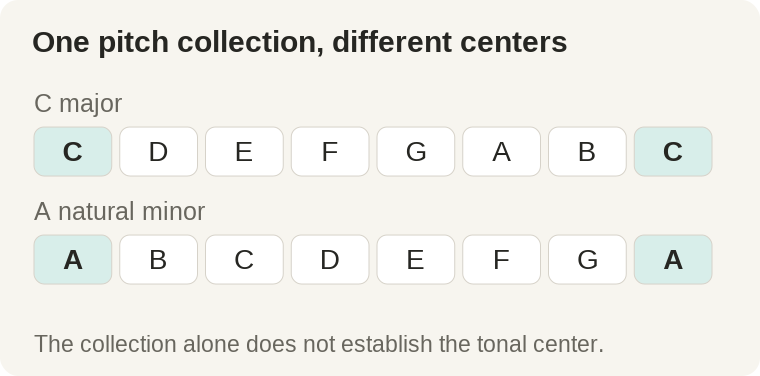
Emphasis, melody and harmony help establish which note feels like home.
Tonic names the center
The tonic is often emphasized through repetition, sustained bass notes, melodic arrivals and harmonic returns. In a C-major context, a G or G7 chord returning to C can help establish that center. In other styles, a repeating loop or a drone may establish a center with less emphasis on that kind of functional chord movement.
A tonic note does not automatically make every ending sound complete, and a melody can end on another member of the tonic chord. The surrounding phrase matters. Open Music Theory's harmonic-function lesson explains tonic and dominant roles in a particular tonal tradition, rather than a requirement for every style of music.
A key and a scale are different descriptions
A scale arranges pitches into a sequence. A key concerns how pitches function around a center in music. Playing a scale can introduce its notes, but musical emphasis and relationships establish the key of a passage.
| Example | Tonic | Basic tonic triad | Starting scale collection |
|---|---|---|---|
| C major | C | C–E–G | C D E F G A B |
| A minor | A | A–C–E | A B C D E F G (natural minor) |
Those two scales share pitch classes but begin from different tonics. A minor-key passage can also use altered sixth or seventh degrees, as in harmonic and melodic minor. Likewise, a major-key piece can use chromatic notes or borrowed chords without losing its center immediately.
Ableton's keys and scales lesson introduces the relationship between tonic and pitch collection. For a controlled chord comparison, see major versus minor.
A key signature gives clues
A written key signature specifies sharps or flats applied by default. It does not prohibit other pitches: accidentals can alter notes within the passage, and the music can change key. A signature with no sharps or flats commonly serves C major or A minor; one sharp commonly serves G major or E minor.
Relative major and minor keys share a signature. Other musical contexts can use the same signature too, so it is not a complete identification by itself. The circle of fifths maps common major and relative-minor key-signature relationships.
Find the center by combining clues
Listen to several phrases rather than only the opening note. Notice which bass note or chord feels like a return, where melodies settle and how the harmony approaches those points. Try humming a candidate tonic while the passage continues, then compare another candidate.
The first or last chord can be a clue, but neither is a universal answer. Some loops remain ambiguous between related centers, and some pieces change key. Use a key label as a starting point, then listen for where phrases feel settled and how the melody and chords support that center.
Our chord progression guide gives a small set of chords to explore once you have a tonic in mind.
Compare centers in Soundroo
Use the Soundroo prompt or connect your chat app. Ask for two short piano-and-bass examples using only C, D, E, F, G, A and B: one organized around C major and one around A minor. Ask the agent to make the chosen tonic clear through bass, melody and phrase endings. Compare the previews while following the two scale rows in the illustration. You are listening for the center, rather than merely counting which pitch classes appear.