Chord Voicings: Arrange the Same Notes in Different Ways
Published November 12, 2026
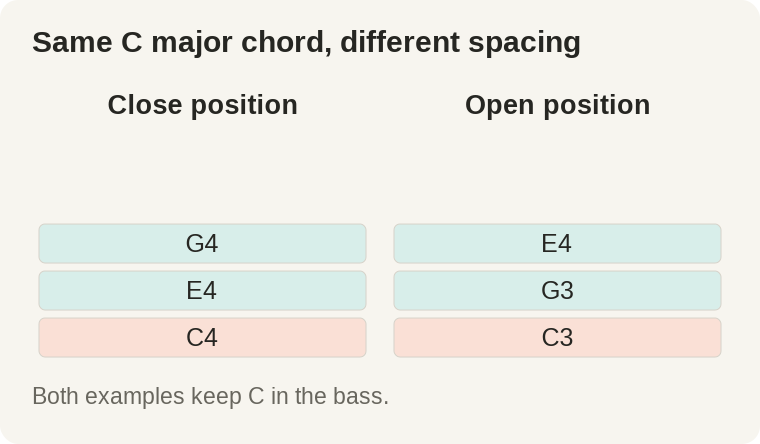
A chord voicing is the way you distribute a chord's notes: their registers, spacing, order and doubling. C4–E4–G4 and C3–G3–E4 both contain the pitch classes of C major, but they place those notes differently.
The illustration compares those two voicings while keeping C in the bass. A different voicing can change the texture or the movement between chords while preserving their basic identity. Start with a simple triad before applying the idea to larger chords.
Voicing concerns register, spacing, order and doubling; inversion specifically concerns the bass note.
Compare close and open positions
A close-position triad places its three members compactly within an octave. C4–E4–G4 is one example; E4–G4–C5 is another. Adjacent notes need not all be thirds: G4 to C5 is a fourth in the second example.
An open voicing spreads chord members into a wider arrangement. C3–G3–E4 puts E above the octave of the lowest C, leaving more space between the parts. Ableton's voicing lesson demonstrates distributing and duplicating chord tones while preserving their shared identity.
| Example | Notes from low to high | Feature |
|---|---|---|
| Close C major | C4–E4–G4 | Compact root position |
| Open C major | C3–G3–E4 | Wider root position |
| Close C major, first inversion | E3–G3–C4 | Third in the bass |
The octave numbers matter. “C–E–G” alone names the pitch classes but leaves many possible voicings open.
Distinguish voicing from inversion
Inversion concerns which chord member is lowest. With C in the bass, a C-major chord is in root position; with E in the bass, it is first inversion; with G, second inversion. Chord inversions develop that particular choice.
You can keep C in the bass and still change spacing, register or the highest note. In a band arrangement, distinguish the upper instrument's voicing from the lowest note in the whole texture: a separate bass part can determine the overall inversion.
Listen to register and density
Several closely spaced low notes can sound more crowded than the same pattern higher up. The result depends on instrument sound, note length, level and the other parts in the arrangement. Try moving one member by an octave or leaving more space between the bass and upper chord notes, then compare.
Doubling repeats a chord member in another register or instrument. A C-major voicing might use C3–G3–C4–E4. That adds another sounding note while retaining the same three pitch classes. Decide what the extra note contributes to the arrangement instead of assuming a larger stack will sound fuller in every useful way.
Connect one chord to the next
Voice leading describes how individual lines move between harmonies. One useful option keeps common tones and uses small movements. From C4–E4–G4, try F major as C4–F4–A4: C stays, E moves to F and G moves to A.
Compare that with moving the entire C-major shape up to F4–A4–C5. Both arrive at F major, but their lines and bass relationships differ. Choose the movement that serves the phrase. Smoothness is one option; a deliberate leap can also be part of the musical idea.
Extend the idea to seventh chords
A seventh chord offers four theoretical chord members to arrange. A player may omit or double some members, with the surrounding music helping establish the chord's identity. If a bass part already supplies the root, the upper part may not need to repeat it.
Begin by hearing the complete chord, then change one voicing choice at a time. This gives you a clear reference before exploring more specialized systems.
Compare voicings in Soundroo
Use the Soundroo prompt or connect your chat app. Ask for a piano exercise alternating C4–E4–G4 with C3–G3–E4, using the same rhythm and note strengths. Then compare the two C-to-F movements above. Keep the instruments fixed so you can follow register and individual-note motion. The instrument arrangement guide shows how to give those notes room among other parts.