Major vs. Minor: Hear the Difference Beyond Happy and Sad
Published November 12, 2026
A major triad has a major third above its root; a minor triad has a minor third. C major is C–E–G. C minor is C–E♭–G. Lowering E by one semitone changes that triad from major to minor while keeping C and G fixed.
Major and minor scales involve a larger pattern. C major and C natural minor differ on the third, sixth and seventh degrees, not just one note. Start by hearing the triads in the illustration, then compare the scales and the musical context around them.
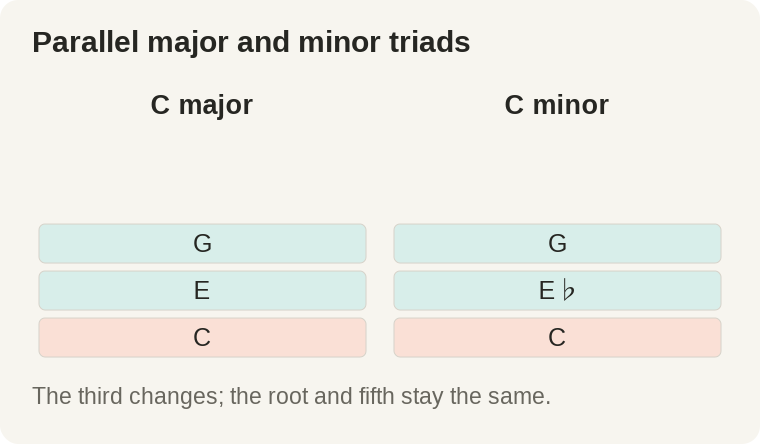
Compare the major and minor third above the same root. Mood also depends on rhythm and context.
Hear the third above the root
An interval measures the distance between notes. A major third spans four semitones; a minor third spans three. On a piano, C to E is a major third, and C to E♭ is a minor third. A semitone is the distance between adjacent piano keys, including the black keys.
Both C-based triads also have a perfect fifth, G, above their root. The changed third distinguishes these two chord qualities. Ableton's lessons on major triads and minor triads let you explore that construction.
“The third” names a chord member, not whichever note happens to sit in the middle of a written voicing. In C–G–E, E is still the third of the C chord even though it is the highest of those notes. Chord voicings explain how spacing can change without changing the chord quality.
Compare parallel scales
Parallel major and minor keys share a tonic, such as C major and C minor. Here are the scale notes for C major and C natural minor:
| Scale degree | 1 | 2 | 3 | 4 | 5 | 6 | 7 |
|---|---|---|---|---|---|---|---|
| C major | C | D | E | F | G | A | B |
| C natural minor | C | D | E♭ | F | G | A♭ | B♭ |
The lower third, sixth and seventh distinguish natural minor from the parallel major scale. Harmonic and melodic minor use other forms of the sixth and seventh. Music in a minor key can draw on those changing degrees; it does not have to stay on one fixed seven-note list throughout.
Relative keys share a collection
Relative major and minor keys share a key signature. C major and A minor are a familiar pair: C major and A natural minor use the same seven pitch classes, but their tonics differ. A minor's tonic is A, not C.
That is different from the parallel C-major/C-minor comparison above. You cannot identify the key just by listing the white notes used, or by spotting one isolated major or minor chord. Melodic emphasis, harmonic movement and phrase endings help establish the center. See what a musical key means.
Go beyond happy and sad
Listeners often use “bright” or “happy” for major and “dark” or “sad” for minor in familiar tonal styles. Those words are listening associations, not definitions of the intervals or guarantees about a piece's mood. Tempo, rhythm, register, timbre, dynamics and the surrounding harmony also affect the result.
Compare the same triads softly and slowly, then with a faster, strongly accented rhythm. Notice what changes beyond the chord quality. Avoid assuming a single chord or the first chord of a progression determines the emotion or key of the entire track.
Compare the triads in Soundroo
Use the Soundroo prompt or connect your chat app. Ask for an eight-bar piano exercise in 4/4 at 100 BPM, alternating one bar of C4–E4–G4 with one bar of C4–E♭4–G4. Keep the rhythm, instrument and note strengths the same. Then try the two scale forms separately. Listen for the changed pitches before choosing words to describe their effect.