Chord Inversions: Change the Bass Note Without Changing the Chord
Published November 12, 2026
A chord inversion places a chord tone other than the root in the bass. C major contains C, E and G: C in the bass gives root position, E gives first inversion, and G gives second inversion. The chord members remain C, E and G.
The bass means the lowest sounding note in the relevant harmony. The notes above it can be spaced in several ways without changing the inversion. The illustration uses three compact examples so you can see the changed bass note clearly.
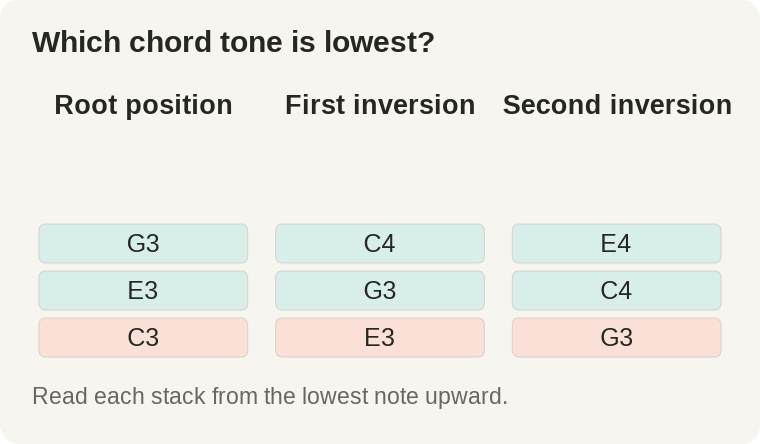
All three contain C, E and G. The lowest note determines the inversion.
Compare the three triad positions
| Position | C-major example, low to high | Common symbol |
|---|---|---|
| Root position | C3–E3–G3 | C |
| First inversion | E3–G3–C4 | C/E |
| Second inversion | G3–C4–E4 | C/G |
The root is still C in all three cases. E remains the third chord member, and G the fifth, regardless of their actual register. Calling the third the “middle note” works only for certain arrangements, so it is clearer to name the chord member.
Ableton's inversion lesson demonstrates these C-major positions. The triad guide explains how the three members are built.
Read a slash as a bass instruction
C/E means a C-major chord with E in the bass. G/B means a G-major chord with B in the bass. Read the letter after the slash as a note, and use the full chord name before it to identify the harmony.
Slash notation can also specify a bass note outside the named chord, such as C/D. That adds a different bass relationship; it is not one of the three C-major triad positions in the table. The distinction helps when you ask an agent to change the bass without accidentally changing the intended chord tones.
Consider the whole arrangement
A piano might play E3–G3–C4 while another instrument supplies a lower C2. The piano's upper voicing has E at its bottom, but the lowest note in the overall C-major harmony is C. Describe the upper voicing and the bass part separately when both are present.
Voicing includes spacing, register, doubling and note order. Inversion is the particular question of which chord member is lowest. You can keep the same inversion while changing several other voicing details.
Use inversions to shape a line
Compare C–G–Am with C–G/B–Am. For the second version, choose bass notes C2–B1–A1. That bass descends by a semitone and then a whole step, while the chord names remain C major, G major and A minor.
This is one voice-leading choice. Root-position chords can also connect effectively, and a larger bass leap may be deliberate. Listen to the individual lines and the phrase ending rather than assuming an inversion always makes a progression smoother or more settled.
Recognize common figured-bass shorthand
Classical analysis often shows triad positions as 5/3, 6 (short for 6/3), and 6/4. These numbers refer to intervals above the bass in the basic arrangement, rather than scale-degree numbers of the chord root.
A seventh chord has another member that can sit in the bass, giving a third inversion. For example, Cmaj7/B places B below the other Cmaj7 members. How a particular inversion behaves in a phrase depends on the style and surrounding harmony.
Hear the bass change in Soundroo
Use the Soundroo prompt or connect your chat app. Ask for separate piano examples of C3–E3–G3, E3–G3–C4 and G3–C4–E4, with the same rhythm and note strengths. Then ask for C–G/B–Am with the C2–B1–A1 bass line. Keep the tempo fixed and compare it with a root-bass version. The bass-line guide gives the next step for developing that line.