Natural, Harmonic and Melodic Minor: Three Minor Scale Forms
Published November 12, 2026
The three familiar minor-scale forms share a tonic and a minor third: natural minor, harmonic minor and melodic minor. They differ mainly in how the sixth and seventh degrees are used. In A minor, the changing notes are F or F♯ and G or G♯.
Treat the forms as useful maps of pitch choices in minor-key music. A piece can mix those choices according to its melody and harmony. Comparing the three A-based rows in the illustration makes the alterations clear without changing the tonic.
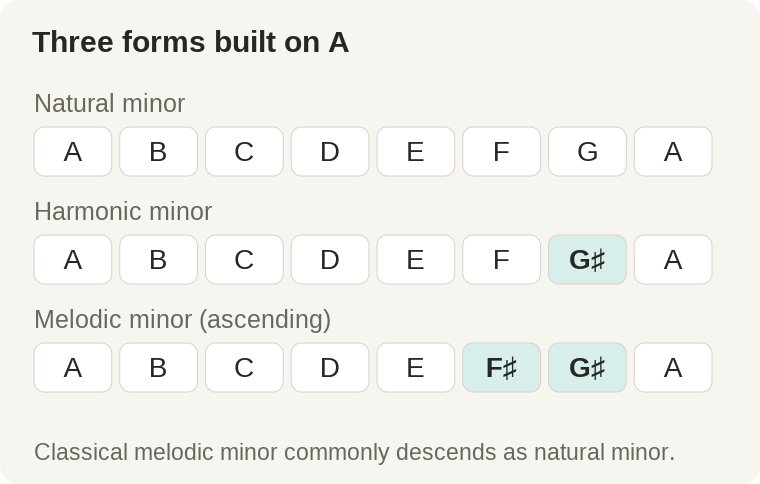
The highlighted degrees change relative to natural minor. Jazz melodic-minor usage differs.
Natural minor supplies the starting collection
A natural minor is A–B–C–D–E–F–G–A. Its ascending steps are whole, half, whole, whole, half, whole, whole: W–H–W–W–H–W–W. The upper A repeats the tonic one octave above the first.
A natural minor shares its pitch collection with C major, but the tonic and the step pattern from that tonic differ. You can also build a parallel natural minor scale by lowering degrees 3, 6 and 7 of a major scale. C natural minor is C–D–E♭–F–G–A♭–B♭.
Ableton's minor-scale construction lesson shows the natural-minor pattern. The major-versus-minor guide distinguishes parallel and relative relationships.
Harmonic minor raises degree seven
Raise G in A natural minor to G♯. A harmonic minor becomes A–B–C–D–E–F–G♯–A. The new G♯ lies one semitone below A and can function as a leading tone.
It also changes available chords. E–G–B is E minor, while E–G♯–B is E major. That major V chord can support movement toward Am. Adding D gives E7, a dominant-seventh chord often used in A-minor harmony.
The F-to-G♯ gap spans three piano semitones and is spelled as an augmented second. That interval is part of the scale's pattern; composers can feature it or use another melodic choice. Open Music Theory explains the minor forms and their changing scale degrees.
Melodic minor has two common conventions
In the conventional classical scale exercise, ascending melodic minor raises both degrees 6 and 7. A ascending melodic minor is A–B–C–D–E–F♯–G♯–A. Descending, the exercise commonly returns to natural minor: A–G–F–E–D–C–B–A.
Actual minor-key melodies are more flexible than a mechanical rule that every upward note must be raised and every downward note lowered. Harmony and phrase context influence the choices.
In jazz theory, “melodic minor” often names the ascending collection used in either direction. When a player or agent receives that label, specify which convention you want. This keeps the note list clear.
Compare the changing degrees
| Form in A | Sixth degree | Seventh degree |
|---|---|---|
| Natural minor | F | G |
| Harmonic minor | F | G♯ |
| Ascending melodic minor | F♯ | G♯ |
All three retain C as the minor third above A. The altered sixth and seventh help explain why a minor key contains more possibilities than one unchanging seven-note scale. The minor-key progression guide applies those possibilities to chords.
Hear one alteration at a time
Use the Soundroo prompt or connect your chat app. Ask for three piano scale exercises on A, with the same tempo, register and note durations. First use natural minor, then change only G to G♯, then also change F to F♯. Ask the agent to label the versions.
Listen to the changing notes and their approach to the upper A. Next, try an Am–Dm–E–Am progression and notice the G♯ in E major. You are comparing specific pitch choices, while rhythm and instrumentation remain available for separate experiments.