Straight vs. Swing Rhythm: Hear and Count the Difference
Published November 12, 2026
Straight rhythm divides paired subdivisions equally. Swing makes a pair uneven, often placing the second note later within the beat. The main-beat tempo can stay fixed while the spacing inside each beat changes.
A common teaching example divides each beat into three equal parts and plays on the first and third positions. That produces a 2:1 long–short spacing. Actual swing ratios vary with the performance and rhythmic level, so the illustration shows one useful example rather than a required ratio.
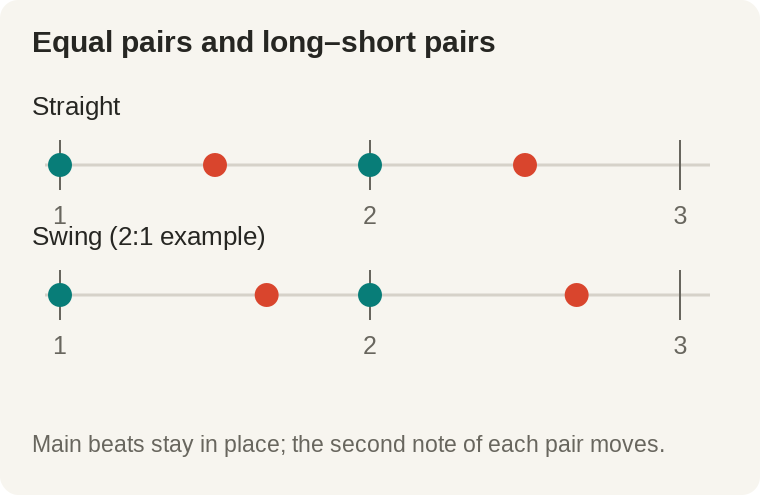
The 2:1 ratio is a counting example, not a fixed rule for every swing performance.
Count equal pairs first
In 4/4 with a quarter-note beat, count straight eighths “1 & 2 & 3 & 4 &.” Each & falls halfway between two numbered beats. The gap from 1 to & equals the gap from & to 2.
Keep a foot tap or metronome click on the numbers and clap both the numbers and & counts. Begin with one repeated pitch or one percussion sound so melody does not distract you from timing. Note values and rests explain how those eighth notes fit inside the bar.
Try a triplet-based swing pair
Count three equal positions per beat as “1-trip-let, 2-trip-let.” Play on the number and on let, leaving the middle position empty. The time from the first onset to the second is two triplet subdivisions; from the second onset to the next numbered beat it is one.
| Pair | First onset | Second onset | Next main beat |
|---|---|---|---|
| Straight | 0 | ½ beat | 1 beat |
| 2:1 swing example | 0 | ⅔ beat | 1 beat |
The diagram keeps the numbered beats aligned and moves the second onset. Note articulation is a separate choice: a short drum hit need not keep sounding for the entire longer gap. Open Music Theory's swing lesson introduces the common triplet-based approximation.
Know which subdivision is swinging
Musicians often discuss swung eighth notes, but production tools can also swing sixteenths or other paired units. A setting that shifts alternate sixteenth-note positions changes a different layer from one that shifts alternate eighths.
Different tools use different percentage conventions and groove templates. Describe the target timing or rhythmic level as well as a number when you give instructions. Straight and swung passages occur across many styles; a genre label alone is not a complete performance instruction.
Separate swing from syncopation
Syncopation concerns emphasis against an expected metrical pattern. Swing concerns the spacing of subdivisions. A straight rhythm can have offbeat accents, and a swung rhythm can repeat a predictable pattern. Moving a whole note to another grid position is also different from slightly adjusting its timing.
For comparison, clap the same repeated eighth-note pattern straight, then with the 2:1 timing above. Keep the accented notes unchanged. Next, move an accent while keeping one timing scheme fixed. You are hearing two different musical choices.
Use the click as a reference
Begin with a quarter-note click on every beat. Later, a half-rate click can mark a larger span. To hear a 60-BPM click on beats 2 and 4 of a 120-quarter-note-BPM exercise, count the clicks as 2 and 4 and supply 3 and 1 between them. Changing the click rate alone does not choose that phase for you.
The metronome guide gives simpler subdivision exercises before that step. You can practice the count by clapping before attempting an instrumental groove.
Compare two Soundroo previews
Use the Soundroo prompt or connect your chat app. Ask for a short 4/4 piano-and-percussion exercise at 100 quarter-note BPM, using paired eighth-note onsets. Request a straight version with second onsets at half a beat and a 2:1 version with second onsets at two-thirds of a beat. Keep the main beats, pitches and accents fixed. Listen to the spacing before applying it to a hip-hop or funk pattern.