Beat vs. Rhythm: How the Pulse and the Pattern Work Together
Published November 12, 2026
The beat is the pulse you count or tap along to. Rhythm is the arrangement of durations, rests and accents in a musical part. A rhythm can match every beat, place several notes within a beat, or hold one note across several beats.
Tap “1, 2, 3, 4” evenly. Keep tapping while clapping a different pattern above it. Your tap provides the beat reference; your clapping has its own rhythm. The rhythm need not be uneven, and the pulse need not be played by a drum.
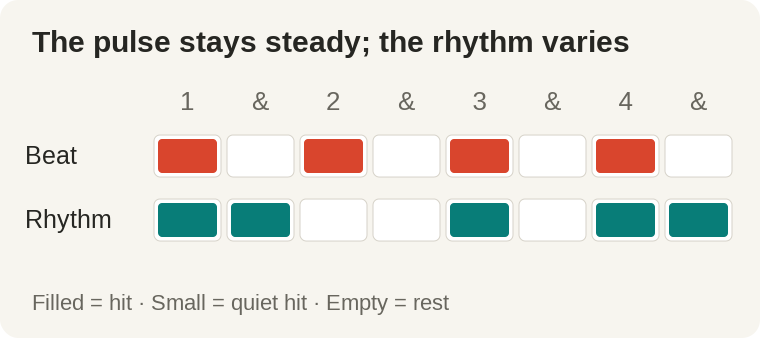
Count the numbered beats steadily while clapping the changing rhythm.
Hear the pulse underneath the notes
In much familiar music, you can feel a regular pulse even when the arrangement leaves spaces. A bass note might last two beats while a hi-hat plays twice per beat. Neither part has to sound on every beat for you to keep counting.
The words beat and pulse are often used similarly in beginner explanations. More specialized discussions can distinguish different levels of pulse, but you do not need a rigid rule that one is an instant and the other a duration to start counting. Ableton's beat and tempo lesson lets you explore the pulse at different speeds.
Some music uses flexible timing or has no clearly regular beat. Even in a familiar song, listeners may tap at different related rates. Finding a useful pulse is a listening skill, rather than proof that everyone must tap at exactly the same speed.
Rhythm includes silence
A part's rhythm describes when its notes begin and how their durations and rests fit together. Four quarter notes, eight straight eighth notes, and one sustained whole note have different rhythms within the same 4/4 bar.
Try this original clapping pattern on an eighth-note grid: clap on 1, the & of 1, 3, 4 and the & of 4. Leave beat 2 and its & silent. Your foot still taps 1, 2, 3 and 4. The silence on beat 2 is part of the clapping rhythm, not an extra pause in the bar.
If those note names are unfamiliar, read note values and rests. You can also compare a sustained note with repeated notes of the same pitch: the pitch stays fixed while the rhythm changes.
Tempo tells you how fast; meter tells you the grouping
Tempo is the rate of the chosen beat, often given in beats per minute. At a quarter-note tempo of 120 BPM, each quarter-note beat lasts half a second. Changing the tempo makes the same rhythmic pattern take more or less time.
Meter groups beats into a recurring pattern. In simple 4/4, you usually count four quarter-note beats per bar. In 3/4, you count three. In standard compound 6/8, six written eighth notes usually group into two dotted-quarter beats. Open Music Theory's meter lesson distinguishes those main beats from their subdivisions. The bar guide provides counting examples.
Moving a few notes between the beats can change the rhythm without changing the tempo or meter. Syncopation uses rhythmic emphasis against an expected metrical pattern.
“A beat” can also mean a backing track
In production and hip-hop, someone asking for “a beat” may mean a whole instrumental backing track, including drums, bass, chords and other parts. In a drum lesson, a beat may mean a particular groove. Use the surrounding conversation to tell that broader meaning from the beat as a pulse.
Try the distinction in Soundroo
Use the Soundroo prompt with your agent or connect your chat app. Ask for a short 4/4 instrumental at 90 BPM with a steady kick and a piano part using our clapping pattern. Then ask for piano notes on every numbered beat instead, keeping the tempo fixed. Count through both previews. You are comparing two rhythms against the same beat reference.