Note Values and Rests: Count Whole, Half, Quarter and Eighth Notes
Published November 12, 2026
Note values describe how long notes last relative to one another. Rests mark spans of silence. In a 4/4 exercise with a quarter-note beat, a whole note lasts four beats, a half note two, a quarter note one and an eighth note half a beat.
Those numbers depend on the beat unit. The relationship between note values stays the same: two eighth notes equal one quarter note, whatever the tempo. Start with 4/4, then distinguish note values from the main beats you feel in other meters.
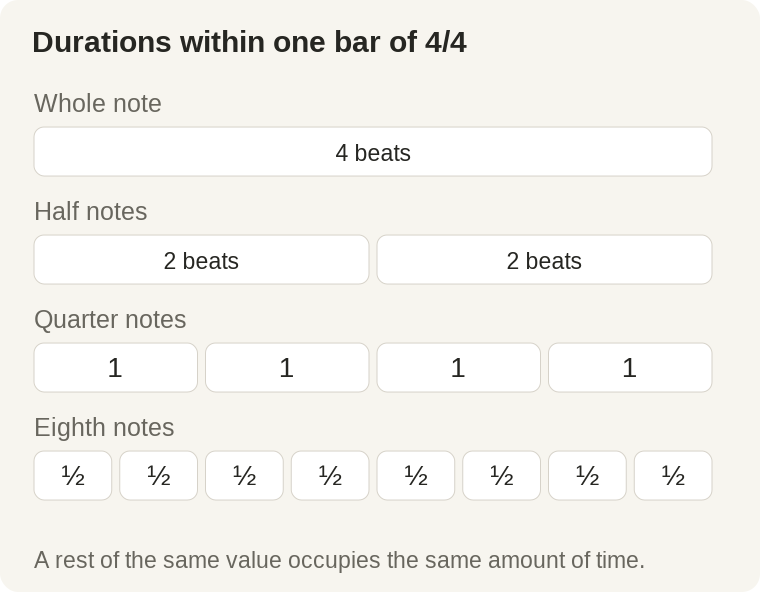
These beat counts assume a quarter-note beat. A rest uses the same duration without a note.
Read the basic note values
A whole note has an open notehead with no stem. A half note adds a stem; a quarter note fills in the notehead. An eighth note adds one flag, and a sixteenth note has two. Beams can join flagged notes into readable groups. Open Music Theory explains these rhythmic symbols and their relative durations.
| Note value | Common British name | Duration with a quarter-note beat |
|---|---|---|
| Whole note | Semibreve | 4 beats |
| Half note | Minim | 2 beats |
| Quarter note | Crotchet | 1 beat |
| Eighth note | Quaver | ½ beat |
| Sixteenth note | Semiquaver | ¼ beat |
The names refer to fractions of a whole note. “Quarter note” does not mean a quarter of every possible bar. A quarter note fills one beat of a 4/4 bar but two of the written eighth-note units in 6/8.
Rests take up time too
A quarter rest occupies the same duration as a quarter note. An eighth rest occupies the same duration as an eighth note. Keep counting through the silence: the next note still has to arrive at its intended position.
On a five-line staff, a whole-rest symbol commonly hangs from the fourth line and a half rest sits on the third line. A whole-rest symbol can also indicate an entire silent measure, including a measure whose duration differs from a whole note. Treat that as a notation convention, rather than assuming every whole-rest symbol means four beats.
Dotted rests are valid notation. How a writer groups rests depends on the meter and on keeping the beats clear; there is no general ban on dots after rest symbols.
Count one complete bar
In 4/4, count quarter notes “1, 2, 3, 4.” For straight eighth notes, count “1 & 2 & 3 & 4 &,” placing each & halfway between the numbered beats. Sixteenth notes use “1 e & a 2 e & a,” with four equal slots per quarter-note beat.
Try a quarter note on beat 1, a quarter rest on beat 2, then four eighth notes across beats 3 and 4. The durations add to four beats: 1 + 1 + ½ + ½ + ½ + ½. The rest is part of that total. It does not shorten the bar or stop the pulse.
Dots and ties extend a duration
A dot adds half the original value. A dotted quarter note equals three eighth notes; a dotted half note equals three quarter notes. A tie joins consecutive notes of the same pitch into one sustained notated duration. Two tied quarter notes last as long as a half note, though the tie can make a beat or bar boundary easier to read.
In standard compound 6/8 meter, the main beat is usually a dotted quarter note: three eighth notes. That gives two main beats per bar. Our bar and time-signature guide shows the difference from 4/4 and 3/4.
Try a note-and-rest pattern
Use the Soundroo prompt with your agent, or connect your chat app, then ask for an eight-bar 4/4 piano exercise at 80 BPM. In each bar, play C on beat 1, leave beat 2 silent, then play four eighth notes on beats 3 and 4. Ask for a preview and count along. For more context, compare beat and rhythm or start a simple drum pattern.