What Is a Bar in Music? Beats, Measures and Time Signatures
Updated November 12, 2026
A bar, also called a measure, groups beats into a repeating unit of musical time. In 4/4, one bar contains four quarter-note beats: count “1, 2, 3, 4,” then start the next bar at 1. In sheet music, vertical bar lines separate the measures.
A beat is the pulse you tap along to. The time signature describes how that pulse and its subdivisions are grouped. A bar does not always have four beats, and its length in seconds depends on the tempo as well as the meter.
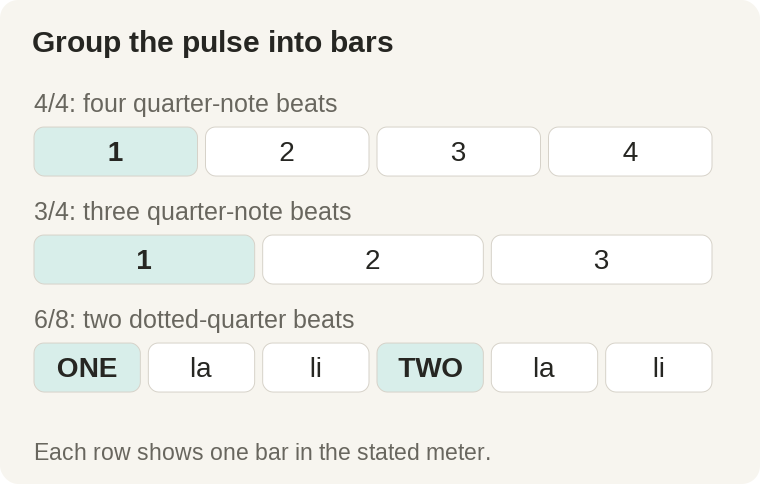
Counting the main beats and their subdivisions helps you place each new bar.
A bar, or measure, groups the beats
Notes and rests are written on a staff, the five horizontal lines used in Western music notation. Bar lines divide the staff into measures. “Bar” and “measure” describe the same unit; a measure can contain sounding notes, rests, or both. Grouping the beats into bars helps musicians keep their place and build larger sections.
The time signature sets the size of the bar
A time signature usually appears near the beginning of the staff as two stacked numbers. In simple meters such as 2/4, 3/4 and 4/4, the top number gives the beats per bar and the bottom number gives the note value used for each beat. A bottom 2 means a half note, 4 a quarter note, and 8 an eighth note. Compound meters such as 6/8 group the written note values differently, as explained below.
In 4/4, there are four quarter-note beats per bar. In 3/4, there are three; in 2/4, two. A waltz commonly uses 3/4, but the time signature alone does not set a mood or a speed. A 2/4 piece can be slow, and a 4/4 piece can be fast.
The numbers look like a fraction, but they describe musical organization rather than a division sum. The usual bottom numbers, such as 2, 4 and 8, come from note values related by halving and doubling. Two common shorthand symbols are C for 4/4 and cut time, a C with a vertical line, for 2/2.
Simple meters divide the beat in two
Many familiar meters are described as simple or compound, depending on how the beat divides. In simple meter, each beat divides into two equal parts, which can divide again into four. Common examples include 4/4, 3/4 and 2/4; other beat groupings are possible.
In compound meters, each main beat divides into three equal parts. In 6/8, the six written eighth notes usually form two main beats, each a dotted quarter note worth three eighth notes. Count “ONE-la-li TWO-la-li.” In the same standard compound-meter grouping, 9/8 has three main beats and 12/8 has four. The top number counts the subdivisions, rather than the main beats.
| Time signature | Main beats per bar | Main beat value | A useful count |
|---|---|---|---|
| 4/4 | 4 | Quarter note | 1, 2, 3, 4 |
| 3/4 | 3 | Quarter note | 1, 2, 3 |
| 2/4 | 2 | Quarter note | 1, 2 |
| 6/8 | 2 | Dotted quarter note | ONE-la-li TWO-la-li |
Downbeats and counting
The first beat of a bar is the downbeat: it marks the start of the next group. It need not be the loudest sound. For example, a rock groove can strongly accent beats 2 and 4 with a snare, a backbeat, while beat 1 remains the downbeat.
Counting aloud is the standard way to keep the beat. In 4/4, count "1, 2, 3, 4" for the quarter notes. When a beat divides in two, add "and" between the numbers, so eighth notes are counted "1 and 2 and." Sixteenth notes add "e" and "a": "1 e and a 2 e and a." The tempo determines how long each beat lasts. At 60 beats per minute in 4/4, each quarter note lasts one second; at 120 beats per minute, each lasts half a second.
Some pieces begin with a pickup, also called an anacrusis: notes before the first complete bar. A pickup is shorter than a full measure. Some scores balance it with a shortened final measure, but that is not required in every song.
Why bars matter in practice
Bars give musicians a shared way to talk about time. A guitarist can say “the chord changes in bar 12,” and an agent can arrange a track into four-bar sections. Four- and eight-bar phrases are useful starting points in many styles, but music also uses other phrase lengths. For the larger sections those phrases can form, see the song structure guide.
How many seconds is a bar?
If the quarter-note pulse is 120 beats per minute, each beat lasts half a second. A 4/4 bar then lasts two seconds, so 16 bars last 32 seconds. At 60 BPM, a 4/4 bar lasts four seconds. The meter gives you the grouping; the tempo gives you the speed.
Try counting bars with Soundroo
Use the Soundroo prompt with your agent, or connect your chat app, then ask:
Use Soundroo to make a 16-bar piano instrumental in 4/4 at 120 BPM. Make four sections of four bars, with a clear change at each section boundary. Keep the rhythm simple so I can count along.
Count four beats, then count another four, keeping track of each new bar. You can ask the agent to move a change to a particular bar or shorten a section. If you want to add drums, start with the beginner drum patterns.