What Is Syncopation? Offbeat Rhythms You Can Count
Published November 12, 2026
Syncopation puts rhythmic emphasis against the beat pattern a listener expects. An important note might arrive between the main beats, or start on a weaker part of a beat and continue across a stronger one. You hear the displaced rhythm in relation to an underlying pulse.
Try counting “1 & 2 & 3 & 4 &” while tapping only on the numbers. Now clap on the & counts. That offbeat-accent exercise is a simple starting point. Syncopation can also involve ties, rests and longer notes; it is more than playing a busy rhythm.
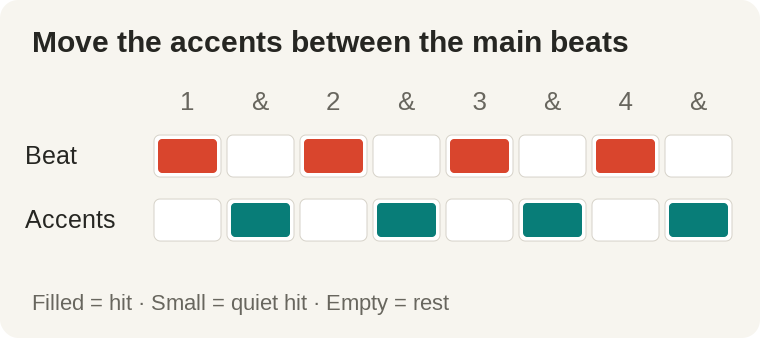
This example accents the offbeats. Keep the numbered pulse going underneath.
Keep the beat as a reference
The beat is the regular pulse. Meter groups those beats, and the musical style helps establish which positions feel accented. Syncopation works against that reference, so you need to hear or feel it even when no instrument plays every numbered beat.
Open Music Theory's lesson on pop and rock syncopation shows how a rhythmic series can shift away from its expected positions. The note lengths and their placement matter together. Simply finding a note between two foot taps does not prove that the entire passage is syncopated.
Count an offbeat pattern in 4/4
Use eight equal eighth-note slots. Keep a foot tap or metronome click on 1, 2, 3 and 4, and clap on the four & counts. Leave the numbered positions silent in the clapping part. Repeat the bar without speeding up between the taps.
Then clap only on the & of 2 and the & of 4. The larger gaps make it easier to hear the claps against the pulse. You can put the same idea in a bass line, chord part or melody. The pulse does not need to move when a note moves to an offbeat.
A different example starts a note on the & of 2 and holds it through beat 3. The sound begins on the weaker subdivision and continues across the next main beat. Note values, rests and ties explain how you can write and count that duration.
Syncopation, backbeats and swing
A backbeat accents beats 2 and 4 in a typical 4/4 groove. Some theory descriptions treat that as a form of syncopation against a traditional strong-beat hierarchy. In rock and related styles, that backbeat is also the listener's familiar expectation. Context matters when you describe what feels displaced.
Swing changes the relative timing of subdivisions, usually making a pair uneven. Syncopation concerns accent and placement against an expected metrical pattern. You can play a syncopated rhythm with straight subdivisions, and a swung passage can have a very predictable accent pattern. See straight versus swing rhythm for that separate comparison.
Practice without losing the pulse
Set a metronome to a comfortable quarter-note pulse. Count subdivisions aloud before adding the offbeat notes. If that is difficult, temporarily use more frequent clicks, keeping clear which clicks are the main beats and which are subdivisions. Return to fewer clicks once you can place the notes.
You do not have to add accents everywhere. A single anticipation before a chord change can be enough. Try the same phrase with and without that anticipation, then listen to how it joins the next beat. Neither version is automatically more interesting; choose the one that supports the musical phrase.
Hear one change in Soundroo
Use the Soundroo prompt or connect your chat app. Ask an agent for an eight-bar 4/4 instrumental at 90 BPM, with a steady kick pulse and piano chords on each numbered beat. Then request a second version with the piano chords on each & instead, keeping the tempo and instruments fixed. Count the beat while comparing the two previews. The funk drum guide applies similar counting to a groove.