Funk Drum Patterns: Build a Groove with Syncopation and Ghost Notes
Published November 12, 2026
A beginner funk drum pattern can combine a clear pulse with kick hits between the beats and quiet snare ghost notes. The contrast between strong and soft strokes matters as much as the number of notes. You can start with a simple groove and change one layer at a time.
The example here uses 4/4, eighth-note hi-hats, snare backbeats on 2 and 4, and a kick on 1, the & of 2 and the & of 3. Add quiet snares just before the backbeats once the basic pattern is steady. This is an original practice groove, not a transcription or a formula for every funk track.
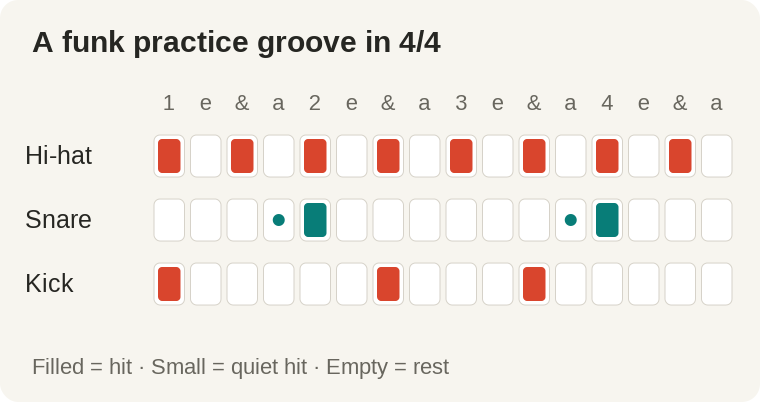
The small snare dots are quiet ghost notes. This is one original practice pattern.
Count sixteenths before adding ghost notes
A bar of 4/4 contains sixteen equal sixteenth-note slots. Count “1 e & a 2 e & a 3 e & a 4 e & a.” The numbered syllables mark quarter-note beats; each & is halfway between two numbered beats. The e and a fill the remaining sixteenth-note positions.
For the hi-hat part, play only the numbers and & counts: eight evenly spaced hits per bar. Put a strong snare on 2 and 4. Begin with kick on 1 and 3 if you want a simpler rock starting point, then move to the kick pattern in the illustration.
Move the kick without moving the pulse
Keep the kick on 1. Place another kick on the & of 2 and another on the & of 3. Those later hits arrive between the numbered beats, while the snare still anchors 2 and 4. Repeat the bar and count through all sixteen slots, including the positions where nothing new sounds.
Syncopation describes emphasis against the expected metrical pattern. Moving a kick to an offbeat changes its relationship to that pattern; it does not require a tempo change. Drumeo's soul and funk teaching guide demonstrates several ways drummers combine displacement, ghost notes and hi-hat details.
Add a quiet snare layer
A ghost note is a quiet stroke, contrasted with a stronger surrounding part. For this exercise, add a soft snare on the a of 1 and the a of 3. Each sits one sixteenth note before the next backbeat. They are the small dots in the illustration; the larger filled snare cells remain the stronger hits on 2 and 4.
First try just the ghost before beat 2. Add the second only when you can keep it consistently quieter than the backbeat. You do not need a fixed stick-height rule or an extra note in every available slot. If you program the pattern, use lower note velocities for the ghosts and listen to the resulting contrast; velocity can affect tone as well as level.
Develop the groove one change at a time
Repeat the pattern for three bars, then use a short fill in the fourth. Another option is to leave the kick and snare unchanged while adjusting hi-hat accents. Compare each variation with the original so you can hear what changed.
A busy pattern is not automatically a better funk groove. The bass line and other instruments also shape the result. If a change obscures the backbeat or makes the transition hard to count, simplify it before adding more notes.
Build the exercise in Soundroo
Use the Soundroo prompt or connect your chat app. Ask an agent for a sixteen-bar instrumental at 95 BPM in 4/4. Specify the hat, kick, backbeat and quiet-snare positions above, with a simple bass part. Preview a version without the ghosts and another with them, keeping the other parts fixed. That comparison makes their role easier to hear.