How to Use a Metronome Without Losing the Musical Pulse
Published November 12, 2026
A metronome gives a regular click at a chosen rate. To use it well, decide what each click represents: a quarter-note beat, a larger beat, or a subdivision. Then count the musical pulse and place your notes in relation to that reference.
Start with one click per quarter-note beat in 4/4. Count “1, 2, 3, 4,” tapping with the click. Next, tap two evenly spaced notes per click and count “1 & 2 & 3 & 4 &.” The illustration shows that second layer between the clicks.
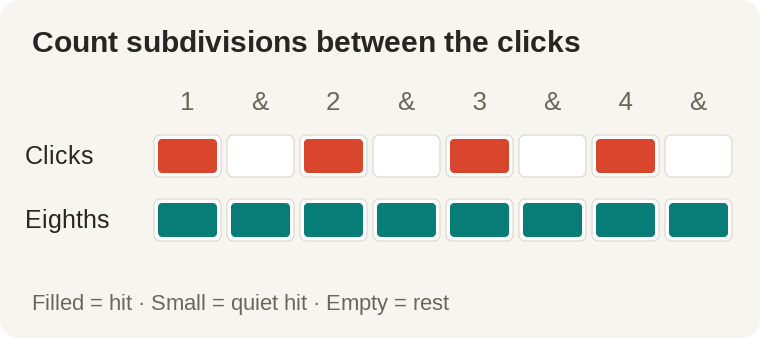
Set one click per quarter-note beat for this exercise; place the “and” halfway between clicks.
Choose a small task and a comfortable rate
Use a short rhythm or phrase you can repeat. Pick a tempo at which you can prepare and place the notes accurately; there is no single correct beginner BPM for every instrument and task. Count one full bar before you begin playing.
Drumeo's beginner drumming lesson uses counting and a metronome to make timing inconsistencies easier to notice. You can do the same with clapping, a keyboard or another instrument. Keep the first exercise small enough that you can listen to the clicks while performing it.
Anticipate the pulse
If you wait to hear a click and then react with a note, the note arrives after the reference. Instead, keep counting the approaching beat so your intended note and click can coincide.
Notice whether you gradually move ahead, fall behind or place some subdivisions unevenly. Restart a difficult phrase at a manageable tempo rather than rushing to catch up. A repeated late entrance differs from gradually slowing down; identifying the pattern helps you choose a smaller exercise.
Fill the spaces evenly
In our quarter-note-beat exercise, eighth notes divide each beat in two and sixteenth notes divide it in four. Clap the subdivisions before playing a more complicated part. Keep counting through rests, because silence still occupies musical time.
Try four bars of quarter notes followed by four bars of eighth notes. The metronome setting stays fixed. Then play a rhythm with a rest on beat 2 and count through that empty space. Note values and rests explain the durations, while beat versus rhythm separates the reference pulse from the pattern you perform.
Hear fewer clicks without slowing the music
Once a click on every beat is comfortable, let the click mark a larger span. At a playing tempo of 120 quarter-note BPM in 4/4, a 60-BPM click can mark beats 1 and 3. A 30-BPM click can mark one complete four-beat bar, if your metronome supports that rate.
| Playing tempo and meter | Click rate | Intended reference |
|---|---|---|
| 120 quarter-note BPM, 4/4 | 120 BPM | Every quarter-note beat |
| 120 quarter-note BPM, 4/4 | 60 BPM | Beats 1 and 3 |
| 120 quarter-note BPM, 4/4 | 30 BPM | Beat 1 of each bar |
| 120 quarter-note BPM, 3/4 | 40 BPM | Beat 1 of each bar |
The click phase depends on how you start counting. Halving the setting does not automatically put clicks on 2 and 4. For that exercise, count successive clicks as 2 and 4, supplying 3 and 1 between them. Berklee's rhythm course outline describes several ways to place and temporarily remove a metronome reference.
Return to a musical phrase
After a timing exercise, play the phrase again and listen to its articulation, accents and direction. A click is a reference for the chosen practice task. If the music calls for flexible timing or tempo changes, decide which passage or pulse you are practicing rather than treating one constant click as the only possible performance.
In Soundroo, use the prompt or connect your chat app. Ask for a short 4/4 piano exercise at 100 BPM with a clear quarter-note percussion pulse, then a version where the percussion plays only on 1 and 3. Count the same four beats through both previews.