3/4 vs. 6/8: The Same Six Eighth Notes, Different Beats
Published November 12, 2026
3/4 has three quarter-note beats per bar. 6/8 usually has two dotted-quarter beats per bar, each divided into three eighth notes. Both can contain six written eighth notes, but those notes are grouped differently.
Count six evenly spaced syllables. Accent them as “ONE & TWO & THREE &” for 3/4, then “ONE la li TWO la li” for 6/8. Keep the syllables equally spaced as you change the grouping. That exercise makes the three-pair versus two-triple organization easier to hear.
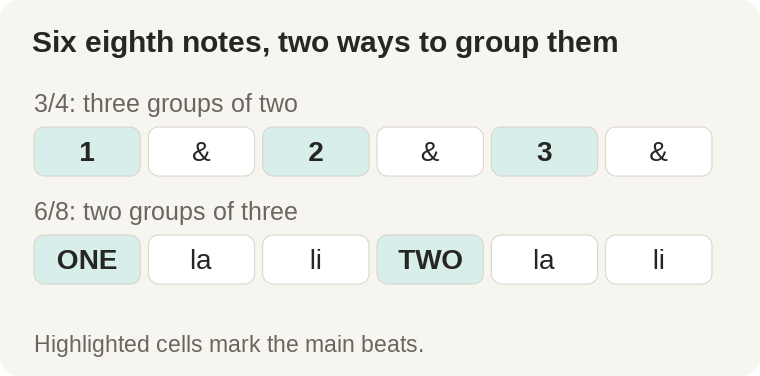
The written eighth-note total matches, but the main-beat grouping differs.
Three groups of two in 3/4
The top 3 describes three main beats, and the bottom 4 identifies a quarter-note unit. Each beat can divide into two eighth notes. This makes 3/4 a simple triple meter: simple because each beat divides in two, triple because there are three beats per bar.
You can count a bar as “1, 2, 3,” then add the eighth-note subdivisions: “1 & 2 & 3 &.” Many waltzes use this meter, but the signature does not require a particular dance, tempo or emotional character. The bar guide places it alongside other common meters.
Two groups of three in 6/8
In standard 6/8 grouping, the top number counts the six written eighth-note units. They form two main beats of three eighth notes each. Three eighth notes equal one dotted quarter note, so that is the usual main-beat value. This is compound duple meter: compound for a three-part beat division, duple for two main beats.
The distinction between written units and main beats is why “the top number always gives the number of beats” is an unreliable shortcut. Open Music Theory's meter lesson explains simple and compound grouping.
You can count the written units “1 2 3 4 5 6,” emphasizing 1 and 4 for this exercise. That 4 is the start of the second main beat, not a fourth dotted-quarter beat.
Compare the two groupings
| Feature | 3/4 | 6/8 in its usual grouping |
|---|---|---|
| Main beats per bar | 3 | 2 |
| Main-beat value | Quarter note | Dotted quarter note |
| Eighth notes per main beat | 2 | 3 |
| Eighth notes per full bar | 6 | 6 |
The illustration highlights main-beat starts. They do not have to be the loudest actual sounds in a performance: an accented melody can work against the underlying grouping. Consider the accompaniment and surrounding phrases as well as individual accents when listening for meter.
The same written total does not guarantee the same duration
How long a bar lasts depends on the tempo and its stated beat unit. Three quarter-note beats at 90 BPM last two seconds. Two dotted-quarter beats at 60 BPM also last two seconds. Those settings give the same eighth-note duration while preserving the different main-beat groupings.
A bare “90 BPM” can be ambiguous when comparing compound and simple meters. Specify whether the metronome mark refers to quarter notes or dotted quarters. See tempo and BPM for the distinction between a tempo setting and a genre convention.
Read grouping without treating it as an absolute rule
Beams often show eighth notes in pairs in 3/4 and threes in 6/8. Composers can use other beaming to clarify phrases or other rhythmic ideas, so “a beam must never cross the middle” is too strict.
Fast 3/4 may be felt as one larger pulse per bar; slow 6/8 may invite counting individual eighth notes. Neither observation automatically swaps the written meter. Music can also alternate or superimpose groupings deliberately, including hemiola effects.
Hear the difference in Soundroo
Use the Soundroo prompt or connect your chat app. Ask for two short percussion examples with the same eighth-note spacing: first group the notes in three pairs, then in two threes. Keep the instrument sounds fixed and make the group starts clear. Count with the illustration, then compare straight and swing subdivisions, which change a different aspect of timing.