Hip-Hop Drum Patterns: Build a Simple Boom-Bap Beat
Published November 12, 2026
A simple boom-bap drum exercise can start with a strong kick, a clear snare backbeat and a repeating hi-hat pattern. The name evokes the kick and snare sounds, but no single arrangement of hits defines all boom bap or all hip-hop.
Our original 4/4 example puts the snare on 2 and 4, the kick on 1, the & of 2 and the & of 3, and closed hats on every eighth note. Begin at 88 BPM if you want a concrete practice setting. That tempo and pattern are starting choices, not genre requirements.
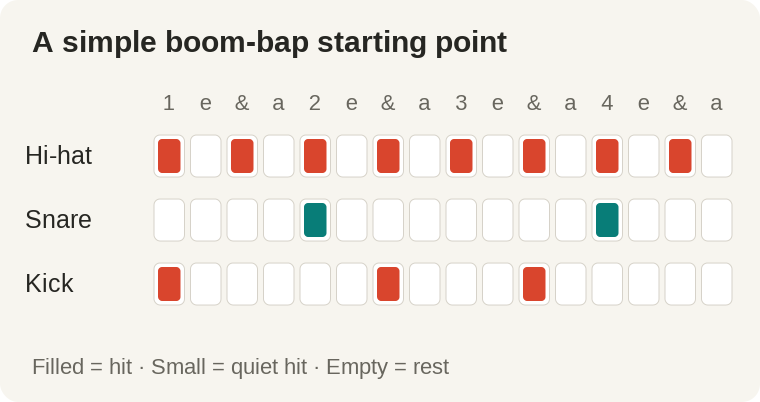
Begin with this straight grid; later compare small timing and velocity changes.
Read the sixteen-step grid
Count “1 e & a 2 e & a 3 e & a 4 e & a.” Each syllable marks one sixteenth note. There are four equal slots within each quarter-note beat and sixteen slots in the bar. The illustration leaves unused positions empty so you can see exactly where each hit belongs.
Start with the snare on the numbered beats 2 and 4. Add the kick on 1. Once that is steady, add the other two kicks on the & counts specified above. Finally, add the eight hi-hats on the numbers and & counts. Keep counting the e and a positions even when they are silent.
The beginner drum guide explains these layers. Native Instruments' drum-pattern lesson also demonstrates how kick, snare and hat placements combine across styles.
Change one kick to make a variation
Repeat the bar several times, then remove the kick on the & of 2 from the fourth bar. The snare and hats stay fixed. That small change gives you a comparison you can identify and count.
Another option adds a kick on the a of 1, just before the snare on 2. Treat this as a separate variation of our starting pattern, not a mandatory boom-bap feature. A funk pattern can share some of the same positions; tempo, sound, accents and the other musical parts help distinguish the result.
Separate swing from other timing choices
Swing makes paired subdivisions uneven. A sixteenth-note swing setting and an eighth-note swing setting act at different rhythmic levels. Different tools can also label their percentages differently, so an unexplained number is not a portable recipe.
Microtiming can instead move a particular hit slightly ahead of or behind a reference. That is different from relocating it by a full sixteenth note. Begin with a straight version so you have a clear baseline, then compare a small, deliberate change. Timing variation does not automatically improve a groove, and a precisely placed rhythm can work well.
Shape accents and quiet notes
Try making every second hi-hat lighter. Listen for the contrast while keeping the hit positions fixed. If you add a snare ghost note, make it clearly softer than the main backbeat and choose a position you can name. There is no universal rule that its velocity must be exactly half the main hit's value.
In a software instrument, velocity may affect sound color as well as level. Use your ears to judge the result. It is also fine to leave the pattern sparse: ghost notes and fills are optional details, not a test that a loop must pass.
Build a short arrangement in Soundroo
Use the Soundroo prompt or connect your chat app. Ask for a sixteen-bar instrumental in 4/4 at 88 BPM, using our kick, snare and hat positions, a simple bass line and a short chord loop. Request the fourth-bar kick variation above. Then compare a straight version with a lightly swung version, keeping the instruments and chord changes fixed.
If the drum rhythm is hard to follow, simplify it before changing the sounds or adding more processing. For the next arrangement step, add a short fill that returns to the next downbeat on time.