Bass Lines for Beginners: Connect Chords and Rhythm
Published November 12, 2026
A bass line is a pattern of low notes that can connect the harmony and rhythm of an arrangement. A useful first exercise follows the roots of the chords, then changes the rhythm or adds another chord tone once the progression is clear.
For the loop C–Am–F–G, start with bass notes C–A–F–G. The illustration shows that relationship. Play one chord per bar in 4/4 and let the bass introduce each new root on beat 1. This is a starting exercise, not a requirement that every bass part always play roots on downbeats.
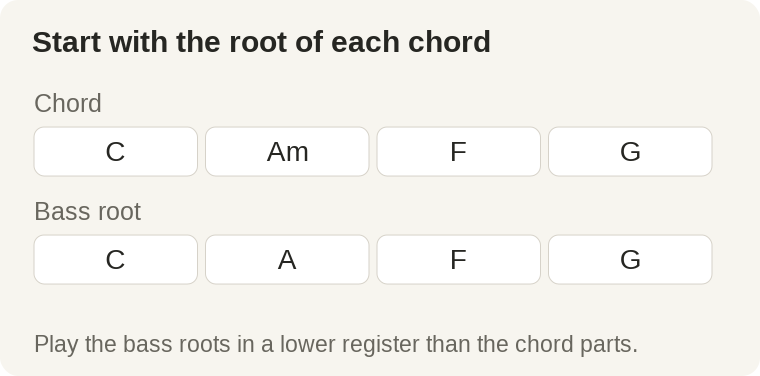
Once the chord changes are clear, vary the rhythm or connect roots with other notes.
Find the root of each chord
C major contains C, E and G; A minor contains A, C and E. The chord's letter name identifies its root, even when its notes are rearranged. Triads introduce those members.
Try this low-register version:
| Chord | Starting bass note |
|---|---|
| C | C2 |
| Am | A1 |
| F | F1 |
| G | G1 |
Those octave choices keep the part in a bass register. You can choose another register to suit the instrument and arrangement. Ableton's bass-line lesson explores low-pitched patterns that support chords and contribute their own rhythm.
Give the roots a rhythm
First hold one root for the whole four-beat bar. Then compare a version with a one-beat root note on 1 and another on 3, leaving 2 and 4 silent. The chord changes stay in the same positions while the bass becomes more rhythmic.
Try aligning those attacks with a simple kick pattern. Later, let the bass answer the kick or leave space around it. Matching every kick hit is one option, not the definition of a coordinated rhythm section. The drum-pattern guide provides a reference groove.
Add another chord tone
Over C major, G is the fifth chord member. A short C-to-G pattern can outline the same harmony with more movement. Over Am, E is a chord tone; over F, C; over G, D. Choose the octave as well as the pitch class so the line moves through an intentional register.
The bass can also play a third or fifth while the upper parts sound the rest of the chord. That can create an inversion of the overall harmony. Keep that change distinct from simply doubling another root.
Approach a destination
An approach note leads into a chosen target. It can occur at different rhythmic positions and may be a chord tone, a scale note or a chromatic note, depending on the phrase.
For our loop, try E1 on beat 4 of the Am bar, then F1 on beat 1 of the F bar. E belongs to Am and moves up a semitone to F. At the end of the G bar, B1 can similarly approach C2 at the start of the next loop. Keep the earlier beats simple while you compare those connections.
Explore a walking rhythm later
A walking bass line often uses a continuing quarter-note pulse in 4/4, combining chord tones and connecting notes. It offers another way to hear the harmony moving through time. Begin with chord tones on the main beats, then try a short connecting motion into the next chord. Keep the pulse steady while you compare the two lines.
Begin by choosing destinations at the chord changes, then decide how to connect them. Arpeggios supply chord-tone patterns, while intervals help describe each movement.
Build and compare the line in Soundroo
Use the Soundroo prompt or connect your chat app. Ask for a sixteen-bar 4/4 instrumental at 100 BPM using C–Am–F–G, one chord per bar. Start the bass with the roots in the table. Request one preview with held roots and another with attacks on 1 and 3. Then add the E1-to-F1 approach in the Am-to-F transition. Keep the other instruments fixed while you listen to what the bass changes.