Chord Progressions in Minor Keys: Start with A Minor
Published November 12, 2026
A minor-key chord progression organizes changing harmonies around a minor tonic. In A minor, Am is the tonic chord: A–C–E. Start with chords from A natural minor, then compare what happens when the seventh scale degree G becomes G♯.
The illustration uses Am–F–Dm–E, one chord per bar. The E-major chord contains G♯ and can lead back toward A. Another useful starting point keeps G natural and uses Em instead. These are musical choices to compare, rather than fixed emotional recipes.
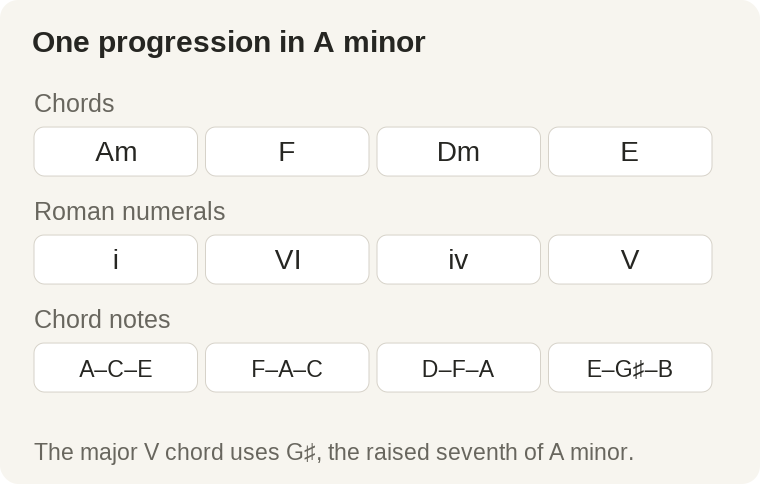
Natural minor supplies G; the raised G♯ strengthens the movement from E back to Am.
Build chords from A natural minor
A natural minor uses A, B, C, D, E, F and G. Building a triad on each degree gives:
| Degree | Chord | Notes |
|---|---|---|
| i | Am | A–C–E |
| ii° | Bdim | B–D–F |
| III | C | C–E–G |
| iv | Dm | D–F–A |
| v | Em | E–G–B |
| VI | F | F–A–C |
| VII | G | G–B–D |
Uppercase indicates a major triad, lowercase a minor triad, and ° diminished. This table uses a minor-key numeral convention in which III, VI and VII name those natural-minor degrees. Charts measured against a parallel-major reference may instead write ♭III, ♭VI and ♭VII for the same chord roots.
The triad guide explains the chord qualities. A minor key can use altered degrees and other harmonies too; this table describes one starting collection.
Hear a natural-minor loop
Try Am–Dm–Em–Am, or i–iv–v–i, holding each chord for one bar of 4/4. Four chords at that rate make a four-bar progression. All of its notes belong to A natural minor.
Repeat the loop while keeping A clear in the bass or phrase endings. A minor and C major share a key signature, so context helps establish the center you hear. Musical keys are more than lists of pitch classes.
Compare v with V
Change E minor, E–G–B, to E major, E–G♯–B. The third of the E chord changes by a semitone. G♯ is the leading tone below A and can strengthen a functional return toward Am.
Open Music Theory's harmonic-function lesson explains tonic and dominant relationships. Minor-scale forms show how the raised seventh relates to harmonic minor. A minor-key piece can mix natural and raised forms according to the passage.
Our illustrated loop, Am–F–Dm–E, is i–VI–iv–V in the convention above. In that example, the major V appears at the end of the four-bar cycle before Am returns.
Try another order and another voicing
Am–F–C–G uses i–VI–III–VII. It draws entirely on natural-minor notes and offers a different root pattern from the V-to-i example. Its tonal effect depends on melody, bass, rhythm and repetition, so listen to the whole phrase rather than assigning one mood to the numeral sequence.
You can keep chord identities fixed while changing voicings, note lengths or the bass rhythm. Adding sevenths creates another comparison: Am7, Dm7 and E7 contain A–C–E–G, D–F–A–C and E–G♯–B–D respectively. A dominant-seventh chord quality does not automatically mean every chord with that quality resolves to the minor tonic; seventh chords separate quality from function.
Compare the loops in Soundroo
Use the Soundroo prompt or connect your chat app. Ask for a piano-and-bass 4/4 exercise using Am–F–Dm–E, one chord per bar, repeated several times and followed by an Am ending. Then request the same exercise with Em replacing E. Keep the tempo, register and rhythm fixed. Follow the chord notes in the illustration and listen for the changed G or G♯ before the return to A.