Drum Fills for Beginners: Simple Patterns and Drum Rolls
Updated November 12, 2026
A drum fill briefly varies or breaks from the main groove. It can mark a transition, answer a musical phrase or add contrast. A drum roll uses repeated strokes to create a rapid pattern or sustained sound. A roll can be part of a fill, but the terms describe different things: a fill’s role in the arrangement and a roll’s pattern of strokes.
A fill can stay on one drum, so you do not have to move around the whole kit. Start with a rhythm you can count, then decide which drums will play it. The examples below use 4/4 and can be practiced on a kit or described to an agent for a Soundroo track.
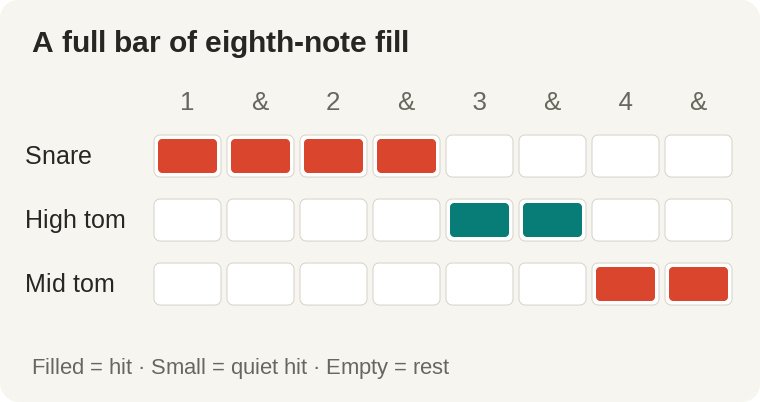
Return to the groove on beat 1 of the next bar; the fill adds no extra beats.
What a fill does and where it fits
Fills can be planned or improvised, and they do not have to be fast. Drumeo’s introduction to fills explains how they can elaborate on a groove or depart from it. In our 4/4 examples, a bar has four quarter-note beats. A full-bar fill uses all four; a half-bar fill can use beats 3 and 4; and a one-beat fill can sit on beat 4.
A common place for a fill is near the end of a phrase, leading into the next section. It replaces or changes the notes in that space; it does not add extra beats to the bar. Keep the pulse going and return to the groove on the next beat 1.
Three simple fills to count and play
In the chart below, X means a hit and - means a rest. Each column is one eighth note. In 4/4, count “1 & 2 & 3 & 4 &”: eight equal slots in one bar. Sixteenth notes divide each quarter-note beat into four slots, giving sixteen per bar.
The eighth-note snare-and-tom fill starts with four snare hits across beats 1 and 2, two high-tom hits on beat 3, and two mid-tom hits on beat 4. First play a simple rock groove for three bars, then replace the fourth bar with this pattern:
Count:     1 & 2 & 3 & 4 &
Snare:     X X X X - - - -
High tom:  - - - - X X - -
Mid tom:   - - - - - - X X
A build-up fill can play snare and floor tom together in steady eighth notes, with kick on each numbered beat. Start quietly and gradually increase the strength of the hits. Keep the note spacing steady while the volume rises.
An around-the-kit fill plays two eighth notes on each of four drums: snare, high tom, mid tom and floor tom. That is eight notes, filling one bar of 4/4. If you play those same eight notes as sixteenth notes at the same tempo, they occupy only two beats. Start that faster version on beat 3 for a half-bar fill, or repeat the sequence twice to fill a whole bar. More notes per beat does not change the tempo.
The three drum rolls to learn first
Single-stroke, double-stroke and buzz rolls are useful patterns to explore. They are not prerequisites for every fill; one hit, a short rhythm or a pause can be enough to mark a change. The Percussive Arts Society’s rudiment collection lists roll patterns alongside other basic drumming vocabulary.
A single-stroke roll alternates hands: R L R L R L R L. A double-stroke roll uses two hits from each hand: R R L L R R L L. Here, R means right hand and L means left. Drumeo’s rudiment introduction demonstrates both patterns. Keep the spacing and strength even before increasing the speed.
A buzz roll, also called a multiple-bounce or press roll, uses several controlled rebounds from each hand to blend the notes into a more continuous sound. It involves a different technique from counting a single-stroke fill. You can learn the simpler counted patterns first and return to buzz-roll technique later.
How to practice fills
Practice fills in context as well as on their own. Play a groove for three bars, play a one-bar fill, and return to the groove. Count through the fill so the next beat 1 arrives at the expected time. Practicing the notes alone helps with coordination; joining them to the groove helps with the transition.
Start at a tempo where you can place each note accurately. A metronome gives you a steady pulse to follow. If you rush during the fill, slow down or use fewer notes, then try the full groove-and-fill phrase again.
For a shorter option, start on beat 3 and play four eighth notes on the snare: “3 & 4 &.” For a one-beat option, play two eighth notes on beat 4. You can also leave beat 4 silent, then return on beat 1 of the next bar. Choose the amount of activity that supports the song’s sections.
Try a fill in Soundroo
Use the Soundroo prompt with your agent, or connect your chat app, then ask:
Use Soundroo to make a 16-bar rock instrumental in 4/4 at 100 BPM. Keep a simple groove, but use four eighth-note snare hits on beats 3 and 4 of every fourth bar. Return to the groove on the next beat 1.
Listen for whether the transition stays in time. Then ask for a version with the same four hits moved from snare to toms. You can compare the sound while keeping the rhythm unchanged. Soundroo renders the agent’s score; your listening tells the agent which changes help the track.