Rock Drum Patterns for Beginners: Beats You Can Count and Build
Updated November 12, 2026
A basic rock drum pattern combines three sounds: the kick drum (the big drum played with a foot pedal that produces a low thump), the snare drum (the sharp crack in the center of the kit), and the hi-hat (two small cymbals that close together with a foot pedal and are struck with sticks).
A common anchor for a rock groove is the backbeat: a snare accent on beats 2 and 4, common in many rock grooves. The kick drum and hi-hat fill in the rest around that anchor. Learn to count the beats, play the three beginner patterns, and add a simple fill to connect sections. These are useful starting points, rather than rules for every rock song.
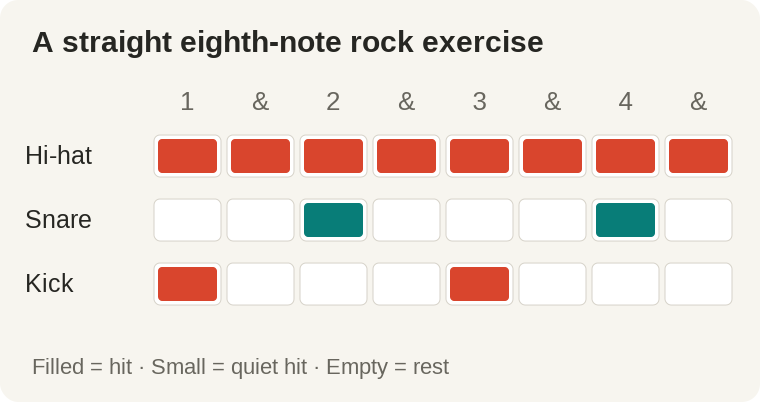
Each column is one eighth note. Count “1 and 2 and 3 and 4 and.”
Count the beat before you play it
The examples here use 4/4 time: each measure, also called a bar, holds four quarter-note beats. Many rock songs use this meter, though others use different meters. You count them "1, 2, 3, 4." Quarter notes are one beat each. Divide each beat in half and you get eighth notes, counted "1 and 2 and 3 and 4 and," where each "and" marks the midpoint between numbered beats. Divide further into sixteenth notes and the count becomes "1-e-and-a, 2-e-and-a," one way to count four equal subdivisions of each beat, at any tempo. Counting music as a drummer is the skill that lets you learn a new beat and follow a metronome; it also keeps you from losing the tempo when you play fills.
A metronome helps because it gives you an audible click for each beat. Start slow, count out loud with the click, and keep the pattern simple until the counting and the playing line up. You can also clap the eighth notes while tapping your foot on the numbered beats.
The three beginner rock beats
These three beginner patterns share a backbeat. A backbeat means an emphasis on beats 2 and 4; it is a feature of the groove, rather than a separate drum or a rule for every rock song.
Four-on-the-Floor. The kick drum plays on all four beats, the hi-hat plays steady quarter or eighth notes, and the snare keeps the backbeat on 2 and 4. The regular kick makes the pulse easy to follow, though you still need to coordinate the kick, snare and hi-hat. This pattern also appears in other styles, including house.
Quarter-note hi-hat beat. In this basic rock groove, the bass drum hits 1 and 3, the snare hits 2 and 4, and the hi-hat plays quarter notes. This combination of hi-hat, bass drum and snare is a common starting point. On a common right-handed setup, the right hand plays the hi-hat, the right foot plays the kick, and the left hand plays the snare. Play slowly until the three parts land together where intended.
Eighth Note Rock Beat. Same snare and bass placement, but the hi-hat plays eighth notes, so the hi-hat sounds twice per beat, on the number and on the "and." The busier hi-hat drives the song forward and prepares you for sixteenth-note grooves. If you want a different cymbal texture, move the same pattern to the ride cymbal; the ride works with any of these grooves.
These three patterns share the same building blocks. Rock and house examples show how closely related grooves can be: keep the snare on 2 and 4, move the kick drum to different counts, and each new placement produces a different feel.
Read all three patterns on one grid
Each column is one eighth note. x means a hit and . means a rest; the spacing is the same in every row. Repeat each block as one bar of 4/4.
Count       1 & 2 & 3 & 4 &

Quarter-note hi-hat beat
Hi-hat      x . x . x . x .
Snare       . . x . . . x .
Kick        x . . . x . . .

Eighth-note hi-hat beat
Hi-hat      x x x x x x x x
Snare       . . x . . . x .
Kick        x . . . x . . .

Four-on-the-floor variation
Hi-hat      x x x x x x x x
Snare       . . x . . . x .
Kick        x . x . x . x .
Add a fill to connect the sections
A drum fill is a short break from the steady groove, usually at the end of a measure or section. It adds variety and makes the transition to the next part of the song feel intentional. Drumeo’s lesson on drum fills describes fills as variations on or departures from the main groove, with lengths that depend on the song.
A useful first full-bar fill is eight eighth notes played around the kit, moving from snare to high tom to middle tom to floor tom with alternating single strokes (right, left, right, left). You can also play the same eighth notes all on the snare. The counting does not change; the fill occupies the same "1 and 2 and 3 and 4 and" you already use for the groove.
To practice the transition, play the groove for one to three bars, play the fill, then return to the groove. Start slowly, with a metronome if possible, and keep counting through the transition. Gradually speed up once the transition is clean. For more examples, see the beginner drum fills guide: keep the fill short, keep it easy to count, and land back on the beat on time.
Keep the same skills for other time signatures
Not all rock stays in 4/4. In 6/8 meter, six eighth notes usually form two main beats, each divided into three. Count “ONE-la-li TWO-la-li,” or count six subdivisions with stronger accents on 1 and 4. That differs from the four quarter-note beats in these examples. The same habit of keeping a steady count helps when you move to another meter.
Build a rock beat with Soundroo
You can try the same placements without playing a drum kit. Connect Soundroo to your AI agent, or use a coding agent with the Soundroo toolkit, then ask:
Use Soundroo to make a 16-bar rock instrumental in 4/4 at 100 BPM. Put the kick on 1 and 3, snare on 2 and 4, and closed hi-hat on every eighth note. Add a simple one-bar fill after three bars, then return to the groove.
Listen and ask for one change at a time, such as an extra kick on the “and” of 3 or a quieter fill. Soundroo turns the agent’s score into audio; the agent cannot hear the result, so your feedback guides the changes. For more styles, see the general drum patterns guide.