How to Arrange Instruments: Give Each Part a Musical Role
Published November 12, 2026
Arranging instruments means deciding what each part plays, when it enters and how it relates to the other parts. You can begin with a small set of roles: a main melody, harmonic support, a bass line, and pulse or accents.
Those are useful starting roles, not fixed assignments. A bass can carry the hook, a guitar can provide rhythmic chords, and a piano can cover several roles at once. The question is what the listener should follow at each moment.
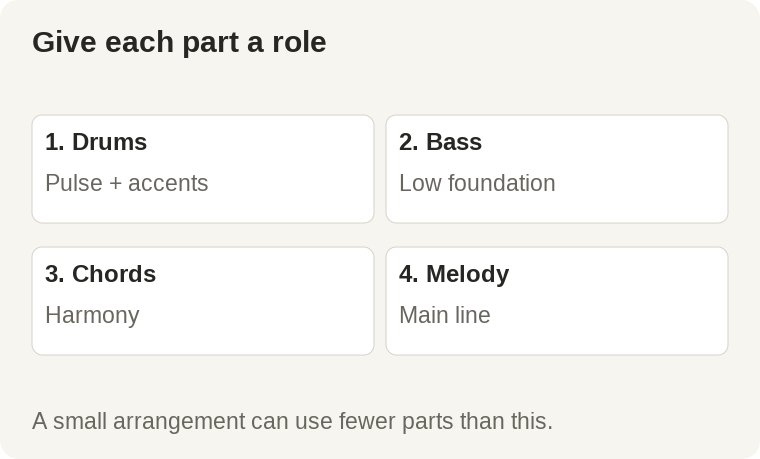
Roles can overlap or move between instruments; leave room for the part the listener should follow.
Give each part a purpose
Start with a melody and decide what it needs around it. A bass can outline the chord roots or provide a moving line. A chord part can supply sustained harmony or a rhythmic pattern. Drums can make the pulse and accents clearer.
Write one sentence for each part: “The piano plays the main phrase,” “the bass connects chord changes,” or “the hats supply a steady subdivision.” If you cannot explain why a part is there, try muting it and compare.
There is no requirement to include all four roles. A solo melody, a drum piece or a melody with only bass can all be complete musical choices. Musical texture describes several ways parts can combine.
Separate parts in register and time
Register is the pitch region a part uses. If two busy parts occupy the same region at similar levels, it can be harder to follow the one you intended as the focus. Try moving one part, simplifying it or letting it answer during a gap.
Keep low chord voicings reasonably open for a first experiment, then compare closer spacing higher up. This is a listening choice rather than a rule that harmony must always stay in the middle. Our voicing guide shows how the same chord can be spaced differently.
Timing provides space too. Let a guitar fill answer the end of a piano phrase instead of playing continuously over it. A sustained chord can support a rhythmically active melody without adding another busy pattern.
Doubling and independent lines are both options
Two instruments can deliberately play the same melody in unison or octaves. The combination may create a stronger line or a different tone color. Compare it with a single instrument and choose which serves the section.
Independent melodies can also work together. That creates a different texture and requires attention to how their rhythms and pitches interact. For a first arrangement, establish one clear main line before adding an answering or contrasting line.
Build contrast across sections
Arrangement also concerns the timeline. Ableton’s song-structure lesson explains how smaller patterns combine into larger sections. Adding a part, removing one or changing its behavior can make a return feel different.
Try this original 16-bar plan in 4/4:
| Bars | Parts and behavior |
|---|---|
| 1–4 | Piano melody and simple bass |
| 5–8 | Add light drums; keep the melody recognizable |
| 9–12 | Rest the melody; let a short guitar phrase answer |
| 13–16 | Return to the piano melody with fuller chords and an ending |
These lengths are an exercise, not required proportions. Ableton’s subtractive arranging approach offers another way to explore the timeline by removing material from a fuller starting arrangement.
Hear the arrangement before polishing it
In Soundroo, ask your agent for the 16-bar plan using available piano, bass, guitar and drum instruments. Play the main melody and bass alone, then bring back the supporting parts. Keep what adds a useful role and revise what obscures the focus.
Make one arrangement change at a time. A quieter mix can help balance a part, but changing its notes, register or entrances may solve the musical overlap more directly.