The Circle of Fifths: Keys, Key Signatures and Chord Relationships
Published November 12, 2026
The circle of fifths places pitch-class names around a circle so that moving clockwise goes up a perfect fifth. Starting at C, the next positions are G, D, A, E and B. On a modern piano, a perfect fifth spans seven semitones.
The diagram shows common major-key names at twelve positions. Some positions have enharmonic spellings, such as F♯ and G♭, which use the same piano pitch classes but different written key signatures. You can use the circle to explore key relationships and chord-root movements.
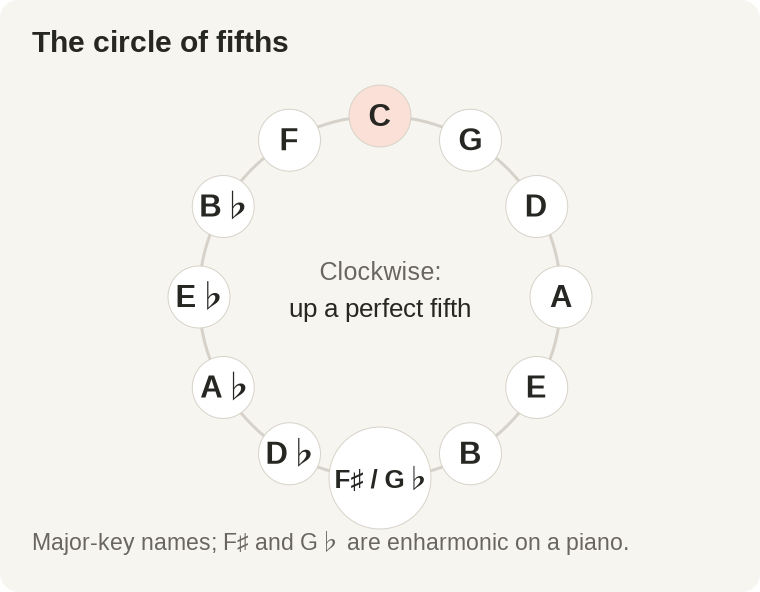
Neighboring keys share many notes. The circle is a map of relationships, not a rule that songs must follow.
Follow the sharp and flat branches
From C major toward G, D and A major, each step adds a sharp to the usual key signature. G major needs F♯, and D major needs F♯ and C♯. Going the other way, C to F to B♭ adds flats: first B♭, then E♭.
| Major key | Default key-signature alterations |
|---|---|
| C | None |
| G | F♯ |
| D | F♯, C♯ |
| F | B♭ |
| B♭ | B♭, E♭ |
The standard sharp order is F, C, G, D, A, E, B; the flat order reverses it: B, E, A, D, G, C, F. Open Music Theory's key-signature lesson explains those written defaults.
Follow a consistent spelling branch when counting. The sharp branch continues through F♯ major with six sharps to C♯ major with seven. D♭ major has five flats, even though it is enharmonic to C♯ major on a piano. Switching spellings is not another “add one sharp” step.
Connect relative major and minor keys
A relative minor shares a major key's signature. Its tonic is the major scale's sixth degree: A minor relates to C major, E minor to G major, and D minor to F major. Some versions of the circle print these minor keys on an inner ring.
The shared signature does not make the tonal centers identical. Minor-key music can also alter scale degrees, especially the sixth and seventh. The key guide and minor-scale guide explain that distinction.
Use the positions as chord roots
For C-major harmony, C, F and G are the I, IV and V major triads. Dm, Em and Am are the minor triads, and B diminished completes the seven diatonic triads. The beginner chord guide lists their notes and numerals.
When reading the circle as a map of chord roots, keep chord quality separate from the major-key labels in the diagram. Dm–G–C follows roots D–G–C counterclockwise. That does not mean the first chord must be D major. Adding sevenths gives the familiar Dm7–G7–Cmaj7 example.
Neighboring positions indicate a relationship you can explore. They do not prescribe every valid progression, nor do they rule out borrowed chords or other movements.
Transpose while preserving the relationships
To transpose, move each pitch by the same interval and preserve the chord qualities. The major-chord progression C–F–G becomes G–C–D when moved up a perfect fifth. Each root moves one position clockwise on this diagram.
Moving C–F–G to D–G–A is a whole-step transposition and moves each root two positions clockwise, not one. Choose appropriate octaves and voicings for the intended register as you transpose. The circle maps pitch-class relationships; your arrangement decides the actual notes and their spacing.
Try a transposition in Soundroo
Use the Soundroo prompt or connect your chat app. Ask for a short C-major instrumental using C, F and G chords. Then ask for the same rhythmic and scale-degree ideas in D major, using D, G and A. Keep the instruments and section lengths fixed. Compare the previews while following the two-step root movement around the circle, then explore chord voicings when the register needs adjustment.