The Pentatonic Scale: Five Notes for Melodies and Riffs
Published November 12, 2026
A pentatonic scale has five pitch classes per octave. Two familiar forms are major pentatonic and minor pentatonic. C major pentatonic is C–D–E–G–A; A minor pentatonic is A–C–D–E–G. Repeating the first note an octave higher completes each ascending scale exercise.
Those two examples share their pitch collection while emphasizing different tonics. They give you a small set of notes for experimenting with rhythm, phrasing and melodic shape. Pentatonic is a broad description; other five-note scales have different interval patterns.
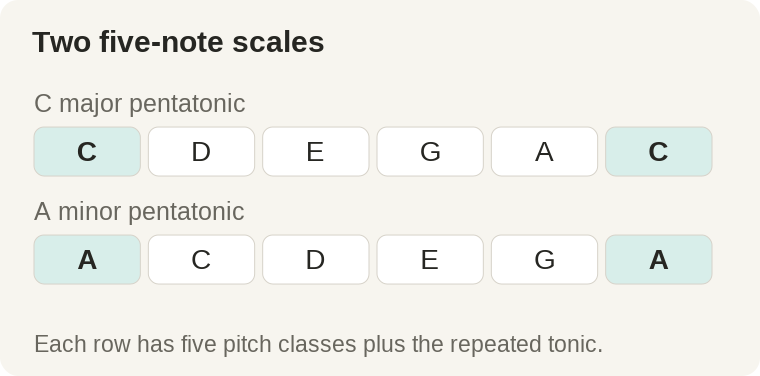
They share a pitch collection; the tonal center and musical context differ.
Build major pentatonic
Start with the C-major scale: C–D–E–F–G–A–B. Remove F and B, degrees 4 and 7. The remaining degrees are 1, 2, 3, 5 and 6: C, D, E, G and A.
The gaps around the octave are two, two, three, two and three piano semitones. That pattern has no half-step gaps between neighboring scale notes, which is why this form is called anhemitonic. In another major key, keep the same scale-degree choices. G major pentatonic is G–A–B–D–E.
The major-scale guide explains the seven-note starting pattern. Its degree numbers let you build the five-note form without relying on one piano-key shape.
Build minor pentatonic
Start with A natural minor: A–B–C–D–E–F–G. Remove B and F, degrees 2 and 6. The result is A–C–D–E–G. Relative to an A-major reference, its common formula is 1, ♭3, 4, 5 and ♭7.
Ableton's pentatonic lesson introduces this minor form and shows a black-key example. On a piano, D♯–F♯–G♯–A♯–C♯ is D♯ minor pentatonic; those pitches can also be spelled E♭–G♭–A♭–B♭–D♭. Which tonic you emphasize helps establish the form you hear.
| Form | Example notes | Degree formula |
|---|---|---|
| C major pentatonic | C D E G A | 1 2 3 5 6 |
| A minor pentatonic | A C D E G | 1 ♭3 4 5 ♭7 |
Use “tonic” for the scale's center. A chord's root is related vocabulary, but a scale does not acquire a new tonal center merely because you happen to play one of its other notes first.
Give the five notes a rhythm
Try C4–D4–E4–G4–A4–G4–E4–C4, one quarter note per pitch. That makes eight beats, or two bars of 4/4. Then repeat some notes, leave a rest or hold the last note longer. You can develop a phrase without adding more pitch classes.
Choose a small idea you can recognize and vary it. An ostinato or riff may repeat an idea, while a longer melody can develop it over changing sections.
Listen to the accompaniment
The absence of half-step gaps within these scale forms is a property of the collection. How a melody relates to a chord underneath it depends on the pitches sounding together. Over a C-major triad, E is a chord tone while D adds another relationship; over a different chord, their roles change.
Aim phrase endings at a chosen chord tone, then compare another ending. Register, accents and note duration can make the same pitch stand out differently. Five notes provide a manageable palette for that experiment, while minor scales and other collections offer additional choices.
Try the palette in Soundroo
Use the Soundroo prompt or connect your chat app. Ask for a sixteen-bar instrumental centered on C major, with a melody using only C, D, E, G and A. Keep the bass and chords simple so you can follow the melody. Then request a version centered on A minor using the same pitch classes. Compare how the tonic, phrasing and accompaniment change the result.