Chord Progressions for Beginners: How Chords Work Together
Updated November 12, 2026
A chord progression is a sequence of chords played one after another. A useful beginner approach is to start with chords from one major key. A key gives the music a tonal center: a note and chord that can feel like home. In C major, the scale notes are C, D, E, F, G, A and B. Songs can also borrow chords or change keys; staying with one scale is a starting exercise, rather than a rule for all music.
Changing the chord order can change the balance of tension and release beneath a melody. Start by learning the seven simple chords built from a major scale, then try a four-chord loop. You can play the examples on an instrument or ask an agent to render them with Soundroo.
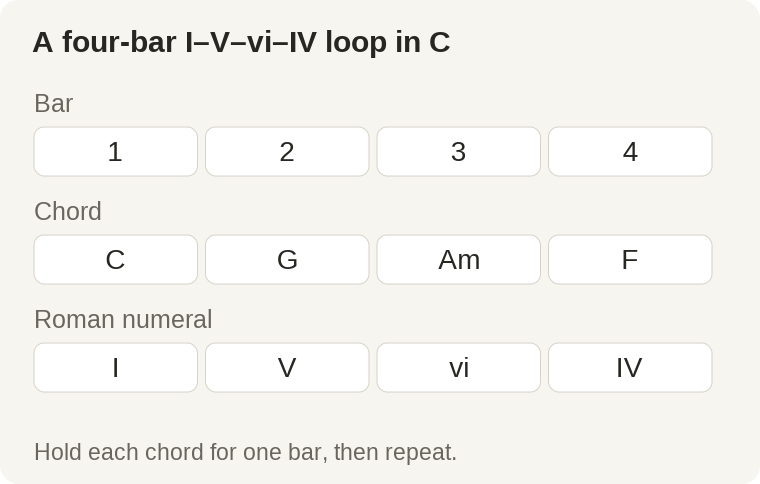
Roman numerals describe each chord’s place in the key, so you can transpose the pattern.
The seven chords inside every major key
To build the seven diatonic triads of a major key, start on each scale note and add the notes a third and a fifth above it, staying within the scale. In note-name order, that means taking a note, skipping one, taking the next, skipping one, and taking the next. C–E–G is a C major triad. These are the triads built from C major:
| Roman numeral | Chord | Notes |
|---|---|---|
| I | C major | C–E–G |
| ii | D minor | D–F–A |
| iii | E minor | E–G–B |
| IV | F major | F–A–C |
| V | G major | G–B–D |
| vi | A minor | A–C–E |
| vii° | B diminished | B–D–F |
The gaps between scale notes are not all the same size, so the triads follow a fixed pattern: major, minor, minor, major, major, minor, diminished. The Roman numerals I, ii, iii, IV, V, vi and vii° label those chords by their place in the key. Uppercase indicates major, lowercase minor, and the small ° marks diminished. A chord symbol such as Am means A minor.
The pattern repeats in every major key. In G major, the I chord is G, the V chord is D, and the vi chord is E minor. Once you learn the pattern, you can find the seven diatonic triads in any major key.
Three jobs: tonic, subdominant, and dominant
One way to understand chord movement is functional harmony. In the traditional harmony of much Western classical music, the I chord has a tonic, or home, role. IV and ii often move away from home toward a dominant chord such as V. V then often leads back to I. In C major, C–F–G–C is I–IV–V–I. These tendencies are useful to hear, but their strength and function depend on style and context.
Related chords can share notes without having exactly the same effect. C major and A minor share C and E, so vi can offer a related color in a C major progression. That does not mean ending on vi always sounds settled. Listen to the melody, the bass and the surrounding chords as well as the chord label.
Three four-chord progressions to try
The chords I, V, vi and IV appear in many pop progressions. In C major, those are C, G, Am and F. I–V–vi–IV is a familiar loop; changing its order gives you other useful starting points. Try these, holding each chord for one bar:
| Progression | Chords in C major |
|---|---|
| I–V–vi–IV | C–G–Am–F |
| vi–IV–I–V | Am–F–C–G |
| I–vi–IV–V | C–Am–F–G |
At one chord per bar, each loop lasts four bars. Repeat a loop while trying a simple melody, then change only one chord and listen again. Tempo, rhythm, instrument choice and how you arrange the chord notes all affect the result; a progression does not guarantee one particular emotion. The guide to bars and time signatures explains how to count the changes.
Hear how a phrase ends
A cadence marks the end of a musical phrase. Chord movement, melody and rhythm work together to make that ending feel settled or open. V–I is a common movement toward the tonic in tonal music. When a phrase sets up an expected return to I but moves from V to vi instead, that can create a deceptive cadence. A phrase ending on V can leave a sense of continuation. Simply finding those chord pairs somewhere in a loop does not by itself establish a cadence.
You do not need to identify every chord immediately. Compare a loop that returns to C with one that stops on G or Am, and listen to how the ending changes. First use root-position triads, with the root note in the bass. Later, try inversions, where another chord note is lowest. The Open Music Theory triad lesson explains chord members and inversions.
Hear a progression in Soundroo
Use the Soundroo prompt with your agent, or connect your chat app, then ask:
Use Soundroo to make a 16-bar instrumental in C major, 4/4 at 100 BPM. Repeat C–G–Am–F four times, one chord per bar. Use piano, bass and a simple melody. Let me hear a preview.
Then ask for a second version using C–Am–F–G while keeping the tempo and instruments the same. Comparing one change at a time makes the chord movement easier to hear. When you have a loop you like, develop a song structure around it or build a short hook. Soundroo renders the agent’s score into audio; you listen and decide which version works.