What Is a Bridge in a Song? Add Contrast Before the Return
Published November 12, 2026
A bridge is a contrasting section within a song. In a common verse–chorus arrangement, it can provide a departure before the chorus returns, using a different melody, lyric perspective, harmony, rhythm or texture.
The illustration shows verse, chorus, verse, chorus, bridge, chorus. That is one useful arrangement, not a requirement for every song. A bridge can appear in another position, have another length or be omitted when the song's existing material provides the movement it needs.
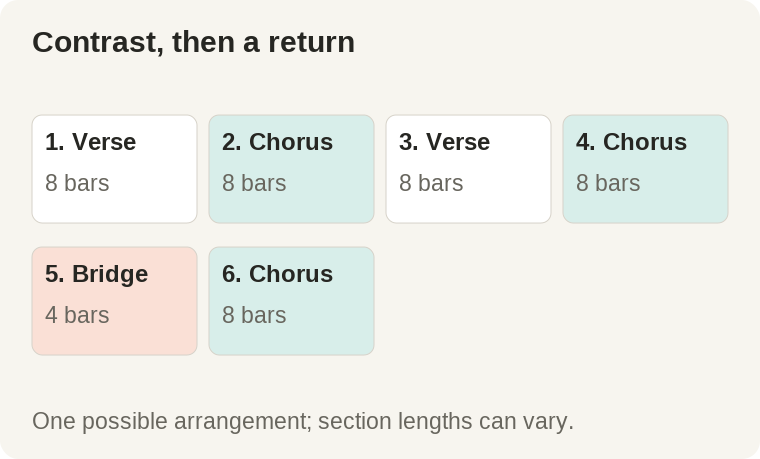
This bridge appears once after the second chorus; other song forms place contrast differently.
Identify what changes
First listen for the recurring verse and chorus material. Then notice whether another section establishes a contrasting idea. It might use new chords, but harmonic change is only one option. The same chords under a new melody or a sparse instrumental texture can also create a departure.
Songwriter Jason Blume's discussion of bridges and song form considers the bridge as an optional songwriting choice. Use its role in the particular song to guide the label and the writing decision.
Choose a place in the arrangement
For an exercise, put a short bridge after two verse–chorus cycles, then return to the chorus. The repeated sections establish a reference, making the departure easy to recognize. Other forms organize contrasting sections differently; in an AABA form, the B section is also often called a bridge.
“Middle eight” is a related term you may hear, particularly in British usage. An eight-bar length is common enough to motivate the name, but the musical function is more useful than assuming every bridge has exactly eight bars or sits at the literal midpoint.
The song-structure guide maps the surrounding sections. A bridge is different from a pre-chorus, which helps prepare a chorus within a returning cycle.
Change one musical feature first
Choose a contrast you can name and compare:
- Keep the chords but use a new melodic contour.
- Move attention from the lead to a bass or percussion idea.
- Change the chord emphasis while staying in the same key.
- Reduce the number of parts after a dense section.
- Change the rhythm or register of a recurring motif.
You can combine choices later. Beginning with one makes it easier to hear whether the new section has a purpose. A bridge need not be the loudest, highest or most complex moment, and it can be instrumental.
Plan a return
Listen to the bridge's final phrase and the next chorus's first phrase together. A shared note, a harmonic approach, a held sound, a rhythmic pickup or a pause can help connect them. A more abrupt return may also be deliberate.
In a C-major exercise, try a bridge that emphasizes Am and F after sections centered on C and G. Those are existing key-related chords, so the contrast can come from emphasis and arrangement rather than a full modulation. Chord progressions and musical keys explain the distinction.
Decide how much space the idea needs
Try four bars first if the contrast fits, then compare a longer version. The right length depends on the phrase, the tempo and the surrounding form. Count the bars so the section arrives and returns where intended; a lyric line is not a fixed number of measures.
A useful check is to listen once with the bridge and once without it. Notice what the departure contributes: a new perspective, a change of focus, room to breathe or a stronger sense of return. That comparison gives you more information than a rule about how many seconds a bridge should last.
Try the arrangement in Soundroo
Use the Soundroo prompt or connect your chat app. Ask for an instrumental with eight-bar verse, eight-bar chorus, eight-bar verse, eight-bar chorus, four-bar bridge and eight-bar final chorus sections. That totals 44 bars. Keep the tempo fixed and make the bridge noticeably sparser, with a different lead idea. Compare the preview with a version that returns directly from the second chorus to the final chorus.