What Is Melody? Pitch, Rhythm, Contour and Musical Phrases
Published November 12, 2026
A melody is a musical line formed by pitches and rhythms unfolding through time. It might be sung, played on a piano or carried by another instrument. When you hum the tune of a song, you are often following its main melody.
Listen for four useful features: the pitches, their rhythm, the contour as they rise or fall, and the phrases that organize the line. These are ways to describe a melody, not a recipe that every melody must follow. A line can even repeat one pitch while its rhythm creates the interest.
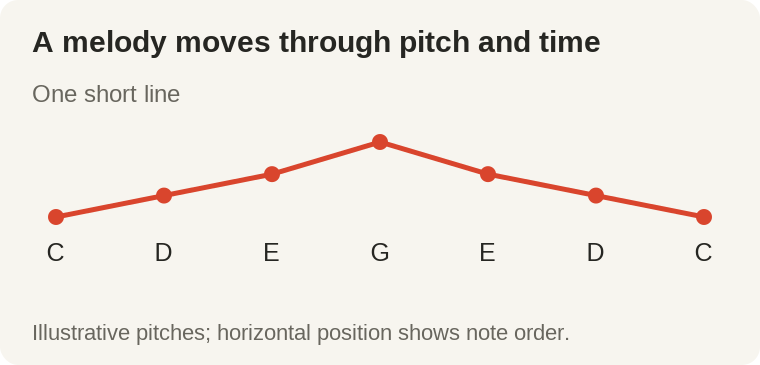
The line shows contour: where a melody rises, falls or repeats a pitch.
Pitch gives each note a place
Pitch describes how high or low a tone is heard. In a clearly pitched musical tone, vibration rate is closely related to pitch: a higher fundamental frequency generally corresponds to a higher pitch. Some sounds, such as many percussion sounds, do not present one clear pitch in the same way.
Name pitches with letters such as C, D and E, adding sharps or flats when needed. An octave number distinguishes registers: C4 and C5 share a pitch-class name, while C5 is an octave above C4. Timbre describes a different feature: why a piano and a flute can sound different on the same pitch.
Rhythm makes the notes into a particular line
The same pitches can form different musical ideas when you change their durations, starting positions or rests. A held note and four repeated notes of the same pitch have different rhythms. Silence can help separate ideas and make a returning note stand out.
A melody can use the steady pulse, divide it or stretch across it. It does not have to play on every beat. Note values and rests explain how to count those choices. Ableton's melody lesson offers a starting point for exploring patterns of single notes.
Contour is the line's shape
Contour describes whether successive pitches rise, fall or stay the same. The illustration rises C–D–E–G, then returns E–D–C. You can trace that broad arch without knowing the exact frequency of each note.
Small movements between neighboring scale notes are steps; larger movements are leaps. Both can contribute to a melody. An interval names the distance between two notes more precisely. A line need not rise and fall constantly to work: repeated notes can emphasize a rhythm or lyric, and a larger leap can create contrast with surrounding steps.
Phrases give the line shape over time
A musical phrase is a group of events heard as a unit. A rest, a held note, a harmonic arrival or a rhythmic change may help mark its boundary. Phrase lengths vary; one short phrase can be a complete idea or part of a longer melody.
Question-and-answer phrasing is one useful option. An opening phrase can leave a sense of continuation, followed by an answering phrase with a clearer ending. That does not make every pair an exact classical antecedent-and-consequent period. For a practical writing exercise, see how to write a melody.
A melody can stand alone or join other parts
A single unaccompanied line is one possible musical texture. A melody can also sit above chords or interact with another independent line. Melody and harmony describe different aspects of that relationship; the melody is not necessarily the highest or loudest instrument throughout a piece.
Hear the illustrated phrase in Soundroo
Use the Soundroo prompt or connect your chat app. Ask for C–D–E–G–E–D–C on piano in one comfortable register. Give each of the first six notes one quarter-note beat, then hold the final C for two beats. That makes eight beats: two bars of 4/4. Listen to a version alone, then one above simple C-major harmony. Keep the notes and rhythm fixed so you can hear what the accompaniment adds.