What Is a Pre-Chorus? Build a Transition into the Chorus
Published November 12, 2026
A pre-chorus is a section between a verse and a chorus that helps prepare the transition. It often creates a sense of movement toward the chorus through melody, harmony, rhythm or arrangement. A verse–pre-chorus–chorus cycle may return later in the song.
A pre-chorus is optional. Some songs move directly from verse to chorus; others use a distinct connecting section. The illustration shows one example with an eight-bar verse, four-bar pre-chorus and eight-bar chorus. Those lengths are exercise choices.
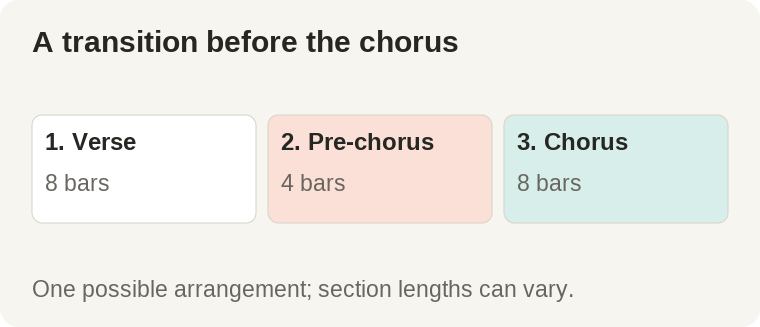
A pre-chorus is optional. Here it connects the verse to the returning central section.
Give the transition a purpose
Listen to the end of the verse and the beginning of the chorus. Decide what relationship you want: a gradual build, a suspended moment, a thinning of texture or a new melodic direction. A pre-chorus can make that relationship audible before the chorus arrives.
Open Music Theory's discussion of formal functions explains how sections can contribute to a larger verse–chorus cycle. A pre-chorus is more than whichever bar happens to come immediately before a chorus; it has a recognizable role and usually some distinct musical material.
Try a harmonic approach
For a C-major exercise, use Dm–F–G–G, one chord per bar, before a chorus that begins on C. The movement toward G can help prepare that return. Another four-bar option holds F for two bars and G for two bars.
| Pre-chorus bar | 1 | 2 | 3 | 4 |
|---|---|---|---|---|
| Chord | Dm | F | G | G |
G is the V chord in C major. Its role depends on context, but G-to-C is a useful way to hear a dominant-to-tonic arrival. The chord-progression guide explains those numerals.
Other harmonic plans can work too. The pre-chorus may retain the verse's chords while changing its melody or arrangement, and it can include the tonic. Choose the target chorus first, then test how the connecting section leads into it.
Change the melodic or rhythmic focus
Try moving a short idea to a new register, repeating a rhythmic fragment, lengthening a note or increasing the number of attacks. You can also create anticipation by removing parts and leaving space. A busier rhythm and a temporary pause are different ways to prepare a new section.
A rising melody is one option, rather than a requirement to stay below a fixed chorus peak. Make the phrase playable or singable for the intended instrument or performer. Melody writing gives a short idea to vary one feature at a time.
Focus the words, if the song has lyrics
In a lyric plan, the verse might develop a situation and the pre-chorus narrow attention toward the central statement. It could ask a question, reach a decision or repeat an important image. A fixed syllable count is not part of the definition, and the title can appear wherever it serves the song.
Try speaking the lines over the planned rhythm. Then compare the transition with and without the section. Keep the version that supports the intended pacing, rather than adding a pre-chorus solely to fill a template.
Distinguish neighboring sections
A chorus returns to a central idea. A bridge often supplies a contrasting departure later in a verse–chorus arrangement. A post-chorus follows the chorus and may extend or respond to it. Placement and function both help identify the section.
Build the example in Soundroo
Use the Soundroo prompt or connect your chat app. Ask for a 4/4 instrumental at 100 BPM with the eight-bar verse, four-bar pre-chorus and eight-bar chorus from the illustration. Use Dm–F–G–G for the pre-chorus and begin the chorus on C. Request one clear transition choice, such as a held lead note or a temporary drop in percussion. Preview it, then ask for the verse-to-chorus version without the connecting four bars.