Melody vs. Harmony: How Musical Lines and Chords Fit Together
Published November 12, 2026
Melody is a line of pitches and rhythms unfolding through time. Harmony concerns how pitches relate and combine, including the chords and chord movements you hear with that line. A melody can stand alone, and harmony need not be a separate instrument sitting underneath it.
A useful beginner picture is horizontal versus vertical: follow the melody from note to note, then notice which pitches sound together at a particular moment. That picture has limits. Chords also change through time, and two independent melodies can create a harmonic result together.
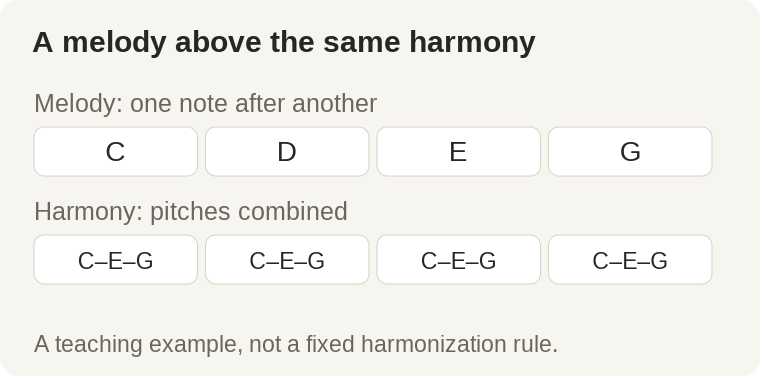
Melody follows a line through time; harmony describes how pitches relate and combine.
Follow one melodic line
A melody has pitch, rhythm, contour and phrasing. Its notes can have equal durations or a mixture of long and short values. It may be sung, played by a lead instrument, doubled by several instruments or passed between parts. It is not automatically the highest note sounding at every moment.
Try the sequence C–D–E–G in a comfortable register. First play the notes evenly, then change one duration. You have kept the pitches but changed the melodic rhythm. Ableton's melody lesson gives a starting point for exploring single-note lines; our melody guide explains the descriptive terms.
Listen to the pitches around that line
A C major triad contains C, E and G. Sound those notes together beneath the melody. Some melody notes coincide with chord tones; D does not belong to that triad, but it can still work as a passing note or another kind of color, depending on its placement and context.
A melody does not have to use chord tones exclusively. Chords can support, contrast with or change the role you hear in a melodic note. Ableton's introduction to chords lets you explore pitches sounded together. Triads are one common chord type, not the only possible harmony.
Change the harmony while keeping the tune
Keep a short melodic phrase fixed and compare it over C major and A minor. C is the root of the C chord but the third of the Am chord. E is the third of C and the fifth of Am. The pitches in the melody have not changed, but their relationships to the supporting chord have.
The result depends on rhythm, register, instrument sound and the surrounding music as well as the chord labels. Major is not a guarantee of happiness, nor minor a guarantee of sadness. The major-versus-minor guide makes a more controlled comparison.
Harmony has rhythm too
Harmonic rhythm means the rate or pattern of harmonic changes. A melody might play several notes over a chord held for four bars. Alternatively, the harmony can change while the melody sustains one note.
Try a four-chord progression with one chord per bar, then with one chord every two bars. You have changed the pacing of the harmony. It may affect the sense of movement, but neither speed guarantees a particular emotional result.
A key supplies a tonal reference, not a rule that every chord and melody note must come from one unchanging scale. Chromatic notes use pitches outside a chosen diatonic collection; a passage need not contain all twelve pitch classes to be described as chromatic.
Put the parts together in Soundroo
Use the Soundroo prompt or connect your chat app. Ask for a two-bar piano melody C–D–E–G–E–D–C: six quarter notes followed by a two-beat final note. Preview it alone, then over a held C-major chord, then over a held A-minor chord. Keep the melodic notes, rhythm and register the same across versions. Listen for how the supporting pitches change the phrase, and explore musical texture when you want more than one melodic line.