House Drum Patterns: Build a Four-on-the-Floor Beat
Updated November 12, 2026
A common house drum pattern starts with four-on-the-floor: the kick drum hits each quarter-note beat in a 4/4 bar. Count “1, 2, 3, 4,” with one kick on every number. Add claps on 2 and 4 and an open hi-hat between the kicks to get a familiar house starting groove.
For this exercise, try 124 BPM, or 124 beats per minute. This is an example tempo, rather than a rule for all house music. You can slow it down while learning the count. The tempo guide explains how BPM relates to different styles.
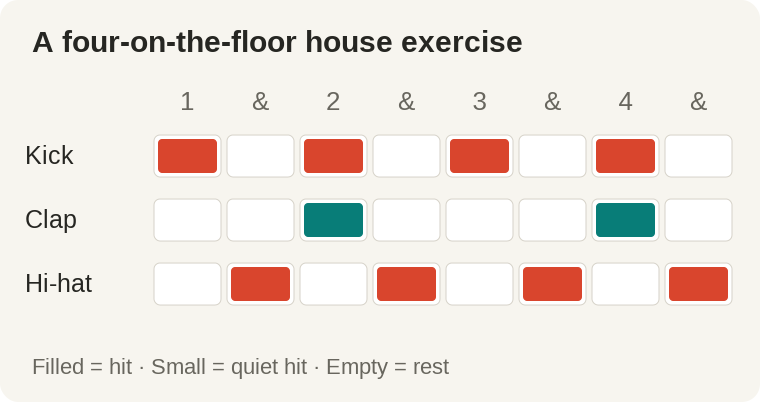
The offbeat hat lands between the kick hits in this basic pattern.
The kick gives you the pulse; the other sounds add emphasis and movement. Start with the three parts below, then change one detail at a time. You can program the positions in music software or ask an agent to build them with Soundroo.
The core pattern: kick, clap and offbeat hat
A classic starting pattern combines a kick on every beat, a clap or snare on beats 2 and 4, and an open hi-hat on each “and.” The clap supplies a backbeat. The hi-hat falls halfway between the numbered beats, so it alternates with the kick. An open hi-hat rings longer than a closed one. This three-part pattern is a starting exercise, not a required arrangement for every house track.
Read the grid from left to right. Each column is one eighth note: a number or an “and.” X means play a hit and . means rest. All three rows cover the same one-bar period.
Count      1 & 2 & 3 & 4 &
Kick       X . X . X . X .
Clap       . . X . . . X .
Open hat   . X . X . X . X
Build the kick row first, then add the clap, then the open hat. On beats 2 and 4, the kick and clap sound together. Between the kicks, the hat plays on its own. Once you can follow the count, add a closed-hat or shaker part if it helps the groove; you do not need every percussion sound at once.
Variations: swing and quieter extra hits
Once the straight pattern is clear, try small changes in timing and hit strength. Swing changes the spacing within pairs of notes, often delaying the second note of each pair to create a long–short feel. It can affect eighth-note or sixteenth-note patterns. Keep the main quarter-note kicks steady while you experiment with the hi-hats, and compare the result with the straight version.
In programmed music, velocity describes how strongly a note is played. It often affects volume and can also affect the tone of the sound. Try making alternate hi-hat hits quieter, or add one quiet extra kick between the main beats. A quiet extra hit is often called a ghost note. Use your ears to decide whether it adds movement or makes the pattern too busy.
House includes many substyles, and a drum pattern alone does not determine the style of a whole track. The bass, instruments, sounds and arrangement also matter. Rock and house examples show how similar basic drum placements can appear in different genres. Learn the shared foundation before treating any variation as a genre rule.
Turn the loop into a small arrangement
Repeating this one-bar pattern makes a loop; an arrangement decides what happens over several bars. Try four-bar phrases: keep the first three bars simple, then make one change in the fourth, such as leaving out a hat hit or adding a short drum fill. Return to the main pattern on the next beat 1. You can also remove the hats for a section and bring them back to make the return more noticeable.
Listen to the three basic parts before adding more instruments. Can you follow the kick, hear the clap on 2 and 4, and pick out the offbeat hat? Adjust the balance if one part masks the others. Add bass and chords after the core beat is clear, then listen again. The beginner chord progression guide gives you a simple place to start with harmony.
Build the pattern with Soundroo
Use the Soundroo prompt with your agent, or connect your chat app, then ask:
Use Soundroo to make a 16-bar house instrumental in 4/4 at 124 BPM. Put a kick on every quarter note, claps on beats 2 and 4, and an open hi-hat on each offbeat eighth note. Add a simple bass line and electric-piano chords. Keep the drums easy to hear.
Listen to the result and request one change, such as quieter hats, a less busy bass line or a short fill in the last bar of each four-bar phrase. Soundroo turns the agent’s score into audio; your feedback guides the revisions. For a comparison with other styles, return to the general drum patterns guide.