Monophonic vs. Polyphonic Synths: One Note or Several
Published November 12, 2026
A monophonic synthesizer plays one independently controlled note at a time. A polyphonic synthesizer can play several notes at once, within its voice limit. That difference matters when you want a chord, overlapping notes or a line whose notes stay separate.
The terms describe note-playing behavior here. They do not tell you whether an instrument has one or two audio output channels, and they do not count how many oscillators it contains.
A monophonic synth can still have multiple oscillators sounding within its one note.
Try three held notes
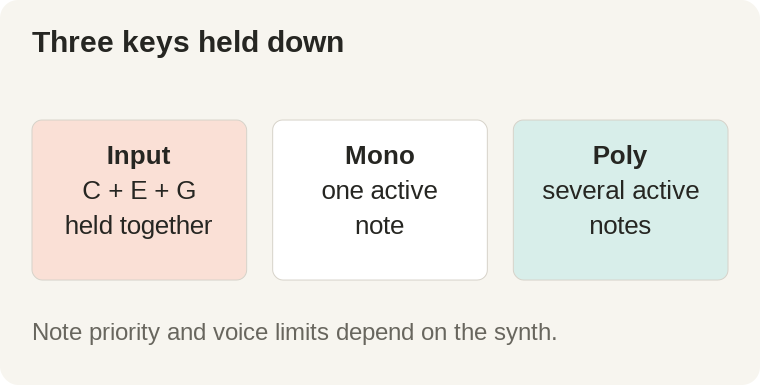
Imagine holding C, E and G together. A monophonic patch chooses one active note according to its note-priority behavior. A polyphonic patch with enough available voices can sound all three together as a C major chord.
The mono patch might favor the newest, highest or lowest held note. The choice depends on the instrument and settings. Moog’s introduction to subtractive synthesis explains monophonic note priority and the relationship between oscillators and voices.
Several oscillators can contribute to one voice. They may be detuned or set to different intervals while still following one key. Counting oscillators alone therefore does not tell you how many independent notes you can play.
What a voice limit means
A voice is an allocated sound-producing path. In a typical polyphonic patch, each new note uses voice resources. Available polyphony depends on the instrument’s design and patch settings.
For a simple hypothetical example, a four-voice instrument plays a three-note chord. If those notes are still sounding when you play another three-note chord, the instrument may need six voices. With only four available, it must stop or reassign some older voices. This is commonly called voice stealing.
A long release can keep notes using voices after their keys are released. Layering and unison settings can also affect voice use. Check the specific instrument rather than converting an oscillator count into a universal voice count. The Ableton instrument reference documents voice settings for its different instruments.
One-note parts and chords
A bass line, lead phrase or arpeggio can work as a sequence of single notes. A monophonic patch can make that line focused and prevent note overlap. A polyphonic patch can play the same line, with release tails allowed to overlap if desired.
Sustained chords require enough simultaneous note capacity. Pads and piano-like parts often benefit from overlap between one chord and the next. If a chord seems to lose notes, shorten the release or simplify the voicing as a comparison before assuming the written notes are wrong.
Legato behavior and glide are separate settings. Overlapping key presses can affect envelope retriggering on some mono patches; glide slides between pitches when enabled. Neither behavior is guaranteed merely by the word monophonic.
Two other meanings to keep separate
Monaural or stereo describes audio channels. A monophonic synthesizer may have stereo effects, while a polyphonic instrument can be recorded into a single channel. Listen to the notes and the output format as separate properties.
In musical texture, polyphony has another meaning: multiple independent musical lines. A polyphonic synthesizer playing block chords does not automatically create that kind of polyphonic texture.
Compare the note patterns in Soundroo
Ask your agent for C–E–G played one note at a time, followed by C–E–G starting together. Use the same available keyboard instrument and keep the level similar. Then compare short notes with overlapping sustained notes.
This demonstrates sequential versus simultaneous writing. Soundroo’s score can describe both; the exercise does not require or imply a mono/poly switch in its interface.