Arpeggio vs. Chord: Play Notes Together or One at a Time
Published November 12, 2026
You can play a chord's notes together or unfold them through time. Sound C, E and G at once to hear a C-major chord; play C, then E, then G to hear those chord tones as an arpeggio. The harmony can remain C major while its presentation changes.
An arpeggio describes the sequence of chord tones, rather than a different chord quality. Its direction, rhythm, register and articulation give you ways to vary the musical texture. The illustration isolates the basic timing difference using the same three pitch classes.
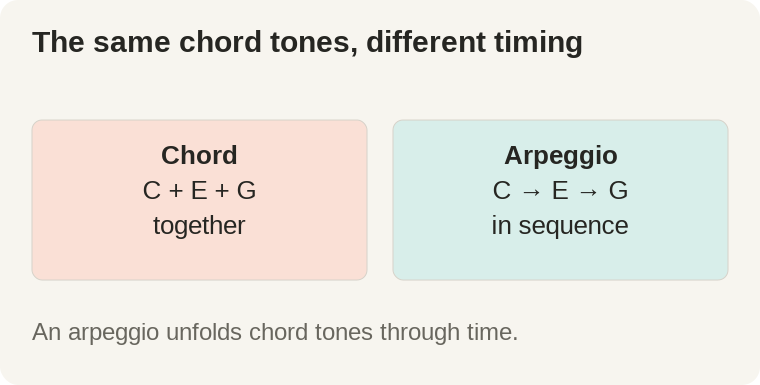
The notes belong to the same chord even when you play them separately.
Keep the chord identity clear
A C-major triad contains C, E and G. An A-minor triad contains A, C and E. Playing the members one after another can outline either chord even when they do not all sound simultaneously. Triads explain those pitch relationships.
A chord can have more members, and you can repeat a chord tone in another octave. An ascending C-major exercise might use C4–E4–G4–C5. The upper C repeats the root's pitch class while extending the register.
Choose an order and a rhythm
Start with a clear ascending pattern, then try descending. Another option is C–G–E–G repeated. Some teachers use “arpeggio” mainly for an ordered rise or fall and “broken chord” for the broader family of separated chord-tone patterns; everyday usage often overlaps.
Give the note order explicitly when you ask a player or agent to make an example. Saying only “arpeggiated” leaves many musical choices open. Ableton's arpeggiator reference describes an electronic approach that produces ordered note patterns from incoming notes; an agent can also write the sequence directly into a score.
Separate onset timing from ringing notes
Notes in an arpeggio can be detached, connected or allowed to overlap. A guitarist may let earlier strings ring as later notes begin; a keyboard player may choose a connected or more separated articulation. Overlap changes the density without changing which notes started in sequence.
A rolled chord is a related performance gesture that spreads the starts of a written chord, often quickly. Not every fast arpeggio has to be notated or performed as a rolled chord. Describe whether you want a short spread or a continuing rhythmic pattern.
Count a controlled comparison
Use one 4/4 bar and the same C4, E4 and G4 pitches:
| Version | Beats 1–3 | Beat 4 |
|---|---|---|
| Together | Start all three on 1 and hold for three beats | Rest |
| In sequence | C4 on 1, E4 on 2, G4 on 3, one beat each | Rest |
Both versions use four beats in total and leave beat 4 silent. The second makes the chord tones into a rhythmic line. Once the contrast is clear, try a four-quarter-note pattern C4–E4–G4–E4 with no rest, or move some notes by an octave.
Fit the part into an arrangement
A sustained chord can leave rhythmic space for a melody, while a broken-chord part can contribute its own motion. Several parts may share these jobs: one holds the harmony while another outlines its notes in sequence. Instrument arrangement helps you decide which part should draw attention.
A single-note instrument can outline harmony through a line, including arpeggios, but that is one compositional option rather than its only possible relationship to harmony. Listen to the phrase and the surrounding parts as well as the note list.
Compare the versions in Soundroo
Use the Soundroo prompt or connect your chat app. Ask for the two one-bar piano examples in the table at 90 BPM, repeated several times with clear labels. Keep the register and note strengths fixed. Then try the same chord progression with held chords in one preview and a repeating chord-tone pattern in another. Listen for the different use of space and motion.