What Is Timbre in Music? Why Instruments Sound Different
Published November 12, 2026
Timbre, pronounced roughly “TAM-ber,” is the quality or tone color that helps us distinguish sounds. A piano and a guitar can play the same written note and still sound different. Their pitch may match while their attack, frequency content and decay do not.
Words such as bright, dark, breathy, metallic and mellow describe aspects of timbre. They are useful listening descriptions, rather than exact measurements or guarantees about how an instrument always sounds.
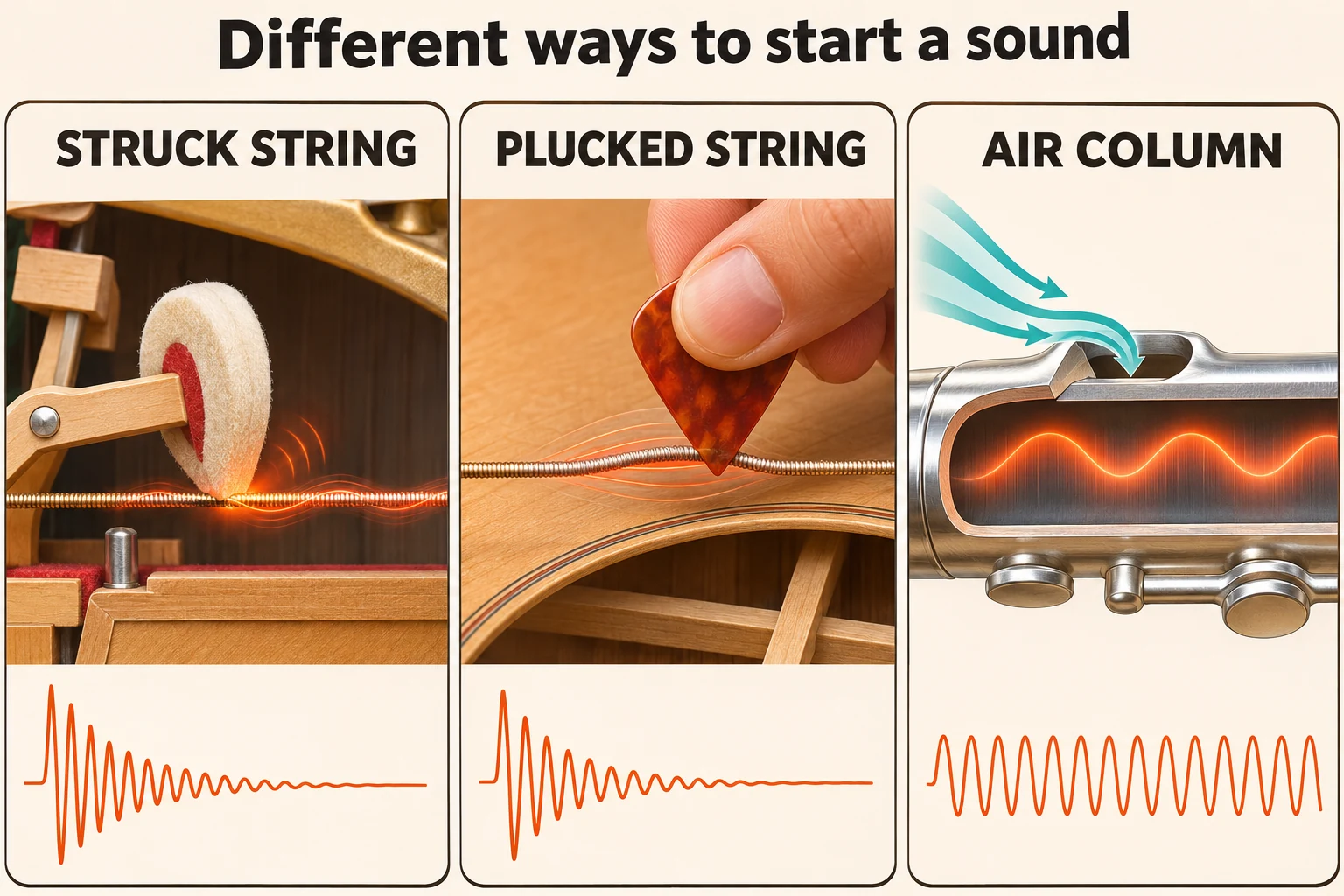
Different excitation mechanisms help create different timbres. The traces are illustrative, not measured waveforms.
How a sound begins matters
A piano hammer strikes strings. A guitar pick or finger displaces and releases a string. A flute player directs air across an opening to excite a vibrating air column. These different ways of supplying energy help shape the beginning of each sound.
Yamaha’s guides explain the piano’s hammer-and-string mechanism and the flute’s air-column vibration. The illustration above compares the mechanisms conceptually; it does not show measured waveforms from particular instruments.
The beginning of a note is its attack. A sharp initial transient can sound very different from a gradual entrance, even when both notes settle at the same pitch. The rest of the note matters too: whether it decays, sustains, fluctuates or becomes noisier changes the impression.
A pitched sound contains more than a note name
Many musical tones contain several frequency components at once. Components at whole-number multiples of a fundamental frequency are harmonics. A harmonic example with a fundamental at 100 Hz could have components at 200 Hz, 300 Hz and 400 Hz, with different strengths.
That is an example of harmonic frequencies, not a claim that every instrument contains exactly that set. Bells and other sounds can have prominent components that do not follow simple whole-number multiples. Breath, bow friction and drum strikes can also introduce noise.
Changing the relative strengths of components changes the sound’s character. Changes through time matter as well. Yamaha’s marimba explanation shows how striking position can affect the balance of an instrument’s vibrational components.
Brightness is one part of timbre
A sound with stronger upper-frequency content is often described as brighter. Reducing that content with a low-pass filter can make it darker. This is one reason a synthesizer can create several tone colors from the same starting note.
Brightness alone cannot describe an entire timbre. Two sounds might both be bright while one has a crisp plucked beginning and the other swells in slowly. Ask separately about the onset, the body of the note and its ending.
Playing technique also changes timbre. Plucking a guitar string near the bridge and near the middle produces different spectral balances. An instrument name tells you a family of possible sounds; it does not specify a single unchanging tone.
Compare timbre without changing everything
Use a short original phrase, such as C–E–G–E with one note per beat. Play it on a piano sound, then an electric piano sound, then a synth lead. Keep the notes, tempo and durations the same, and make the levels reasonably similar by ear.
Listen for three things: how quickly each note starts, whether it fades while held, and whether its upper frequencies feel prominent. A louder example can seem more impressive, so reduce the louder part before choosing a favorite.
In Soundroo, ask your agent for those three versions of the same phrase. Then choose one instrument and request a timbre change, such as a softer onset or darker tone, using its supported controls. This separates the composition from the sound used to play it.