What Is a Synthesizer? Oscillators, Filters and Amplifiers
Published November 12, 2026
A synthesizer is an electronic instrument that creates and shapes sound. It can produce a sustained pad, a sharp bass note, a bright lead or a sound without an acoustic equivalent. Synthesizers can be physical instruments or software.
One useful starting point is subtractive synthesis: begin with a harmonically rich sound, then shape its tone and loudness. The oscillator–filter–amplifier path below is a common teaching model, rather than a universal design for every synthesizer.
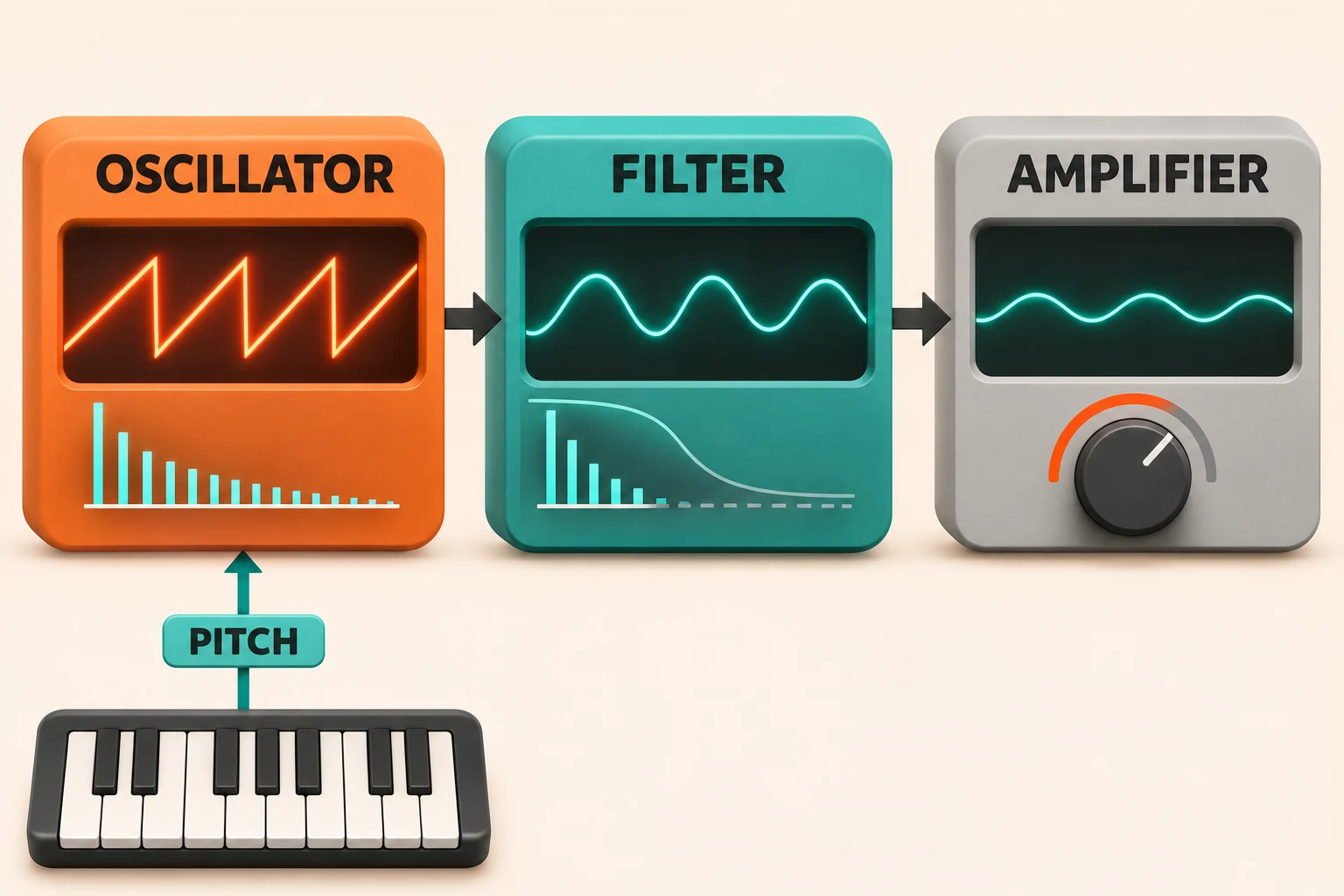
One common subtractive signal path. The modules are an explanatory illustration, not a Soundroo interface.
The oscillator supplies the starting sound
An oscillator generates a repeating signal. Its repetition rate helps determine the pitch: faster repetition gives a higher pitched periodic tone. The waveform influences the starting tone color, or timbre.
A sine wave contains a single frequency. A sawtooth or square wave has a more complex spectrum, giving a filter more material to shape. A synthesizer may also use noise, samples or other sound sources; not every source is a repeating pitched wave.
For a first comparison, keep one note and its loudness steady while switching between a sine-like sound and a richer waveform. Listen for the change in tone color rather than changing the melody at the same time.
The filter shapes brightness
A low-pass filter attenuates higher frequencies while letting lower frequencies through more readily. Lowering its cutoff usually makes a rich starting sound darker. Raising it lets more of the upper spectrum through. A real filter has a transition region, so cutoff is not a perfectly sharp boundary between audible and absent frequencies.
Ableton’s interactive filter lesson lets you explore this relationship. Other filter types emphasize or attenuate different frequency regions, but a low-pass filter is enough for this first patch.
If a sound seems dull, try opening the filter before raising its level. Brightness and loudness can affect each other perceptually, but they are different controls.
The amplifier controls level over time
The amplifier stage controls the signal’s level. An envelope can tell that stage how to respond when a note begins and ends. A common ADSR envelope has four stages: attack, decay, sustain and release.
A short attack reaches its initial peak quickly. A longer attack fades in. Release controls how the sound fades after the note is released. Sustain is a level maintained while the note is held, rather than a duration in seconds. Ableton’s decay and sustain lesson demonstrates the distinction.
Envelopes can also control a filter or pitch. An amplitude envelope changes level; a filter envelope changes the cutoff over time. Keep track of what the envelope is connected to before predicting the result.
Other ways to synthesize sound
Subtractive synthesis is one approach. FM synthesis uses one signal to modulate another’s frequency, producing new spectral components. Additive synthesis builds a sound by combining components. Sample-based instruments start with recordings, which may also pass through filters and envelopes.
These approaches can coexist in one instrument. Learning a clear signal path is more useful at first than trying to memorize every synthesis category. The Ableton instrument reference shows how different instruments combine sound sources and controls.
Try one change at a time
In Soundroo, ask your agent for a short repeated melody using an analog lead. Request two versions with identical notes, rhythm and level, but different brightness settings. Then keep the brighter setting and compare a quick attack with a slower attack.
Soundroo’s instrument controls vary by instrument, so ask the agent to check the available controls rather than assume every patch has a full synthesizer panel. Listen for the difference between changing pitch, changing brightness and changing the note’s onset. Those three comparisons make the signal path much easier to understand.