How to Describe Music to an AI Agent: Tempo, Mood and Arrangement
Published November 12, 2026
A useful music brief tells an AI agent what to make and which musical choices matter to you. Start with the purpose, a few sound preferences and a clear length. If you know the tempo, instruments or structure, name them. If you do not, ask the agent to propose a starting point.
In Soundroo, the agent writes an editable score and uses the renderer to turn its notes into sound. That makes requests such as “keep the melody, move the bass entrance to bar 5” more useful than repeatedly asking for something “better.”
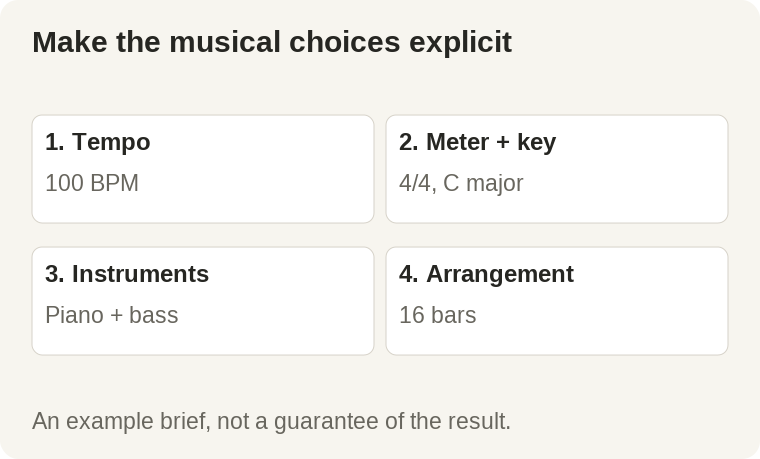
Listen to the result, then change one musical choice at a time.
Say what the music is for
“An instrumental background for a quiet tutorial” gives a different direction from “a short, energetic game menu theme.” Explain whether the music should attract attention, leave space for speech, loop smoothly or finish with a clear ending.
Choose two or three descriptive words, then connect them to musical actions. For example, “gentle, spacious piano with long gaps between phrases” is easier to act on than “beautiful music.” Mood words are personal; they give direction without guaranteeing the same reaction from every listener.
Give tempo and meter when they matter
Tempo describes the speed of a counted beat. Ableton’s beat and tempo lesson gives an interactive introduction. You can request “100 BPM in 4/4” to establish a specific pulse and grouping.
If you do not know the number, use an everyday description and invite a suggestion: “a relaxed walking pulse; choose a starting tempo.” After listening, ask for a small change and keep the notes the same for comparison. A genre can suggest an approach, but it does not require one exact BPM.
For compound meter, be clear about the beat unit when specifying tempo. Our 3/4 and 6/8 guide explains why the same written subdivisions can form different main beats.
Name the instruments and their jobs
A short list with roles is enough for a first sketch: piano carries the melody, electric bass supports the roots, and light drums mark the pulse. Ask for a pad only in the second half if you want a gradual increase in density.
You can also describe articulation: short bass notes, sustained chords, a soft attack, or a brief fill before the return. These instructions concern how the parts behave, rather than merely listing instruments. Use the arranging guide when several parts compete for attention.
In Soundroo, have the agent check the instrument catalog for available sounds and tone controls. Soundroo supports instrumental writing and processed spoken material; do not request natural sung vocals as though a singing model were part of its renderer.
Try a complete, compact brief
Make an original 16-bar instrumental in 4/4 at 100 BPM, centered on C major. Use piano for a simple melody, electric bass for the low foundation, and light drums. Keep bars 1–8 sparse; add soft sustained chords in bars 9–16. Finish with a clear ending and leave room for the final notes to fade.
This is an example, not a required formula. You can leave the key or exact tempo open when you want the agent to choose. Avoid packing the brief with instructions you do not care about.
Revise what you can hear
After the first render, pick one specific change: reduce drum activity, lower the bass, shorten the melody, or make the second section denser. Say what should remain: “keep the chords and tempo.” Compare versions before making the next request.
Start from Make music, which provides the connection prompt for your agent. Listen before choosing a revision. A technically valid score is a starting point for musical decisions, and a concise description of what you hear is useful feedback.