Drum and Bass Patterns: Build a Two-Step Breakbeat
Published November 12, 2026
A useful drum-and-bass starting pattern puts the snare on beats 2 and 4, with kicks on beat 1 and the “and” after beat 3. At a fast tempo, that small change from a straight rock-style kick pattern creates a distinctive repeating shape.
This guide teaches one two-step exercise in 4/4. Drum and bass also uses other drum patterns, chopped breaks and different rhythmic feels; one grid does not define the whole style.
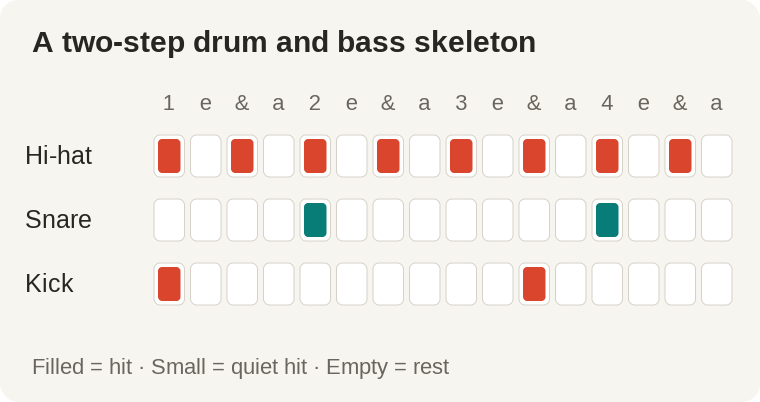
The beat positions stay simple even when the quarter-note tempo is fast.
Start with the pulse and backbeat
Choose a tempo and count four quarter-note beats per bar. Native Instruments’ drum-pattern guide includes a drum-and-bass example at 174 BPM. You can use that as a comparison tempo after learning the positions more slowly.
The snares in this exercise land on 2 and 4. Those are the backbeats. A fast BPM by itself does not make a pattern half-time: the relationship between the counted pulse and the drum accents determines that feel. See half-time and double-time for a direct comparison.
Keep counting the numbered beats while you add subdivisions. Say “1 and 2 and 3 and 4 and.” Each word occupies one eighth-note position.
Program one bar of two-step
Use the following original exercise. Each column is one eighth note, “x” is a hit and “.” is an empty position. The diagram above shows the same placements.
| Count | 1 | & | 2 | & | 3 | & | 4 | & |
|---|---|---|---|---|---|---|---|---|
| Kick | x | . | . | . | . | x | . | . |
| Snare | . | . | x | . | . | . | x | . |
| Closed hat | x | x | x | x | x | x | x | x |
First play the kick and snare alone. Notice that beat 3 has no kick: the second kick waits until its following “and.” That is the position most easily lost when programming the pattern from memory.
Bring in the hats to make the subdivisions audible. Then temporarily mute them and check whether you can still count the gap between the second snare and the delayed kick. Repeat several bars without inserting an extra beat at the loop boundary.
Add a quiet variation
Once the main pattern is clear, add a quiet snare on the last sixteenth of beat 2, counted “a” in “2 e and a.” This is an optional ghost-note exercise, rather than a required feature of every two-step.
Keep that hit distinctly quieter than the snares on 2 and 4. If it competes with them, remove it or lower its velocity. You can also alternate stronger and softer hat hits while keeping their timing fixed.
Change one layer at a time. Moving every hit randomly can obscure the pattern you are trying to learn. Funk patterns provide another setting for exploring ghost notes and accents.
Expand the pattern into a phrase
Repeat the basic bar across eight bars. Leave the first four stable. In bar 8, replace the final beat’s hats with a brief snare variation, then return to the original kick on beat 1 of the next phrase. The variation occupies existing time; it does not lengthen the bar.
A sampled break is recorded drum audio that can be sliced and rearranged. A programmed breakbeat uses individually placed events. Soundroo’s score-based exercise here uses programmed notes and available drum instruments.
In Soundroo, ask your agent for this eight-bar pattern, first with kick and snare only, then with hats and the quiet snare variation. Add a simple bass part afterward and listen for whether the main drum accents remain clear.