Half-Time vs. Double-Time: Change the Feel Without Changing BPM
Published November 12, 2026
Half-time feel spreads a groove's main rhythmic accents farther apart. Double-time feel places a comparable pattern at a faster rhythmic level. You can make either change while keeping the same quarter-note BPM in your score or music software.
In a simple 4/4 drum exercise, normal backbeats land on 2 and 4. A half-time version can place one main snare hit on 3. A double-time version can alternate kick and snare at the eighth-note level, with snare hits on each &. These are reference patterns, not universal rules for every style.
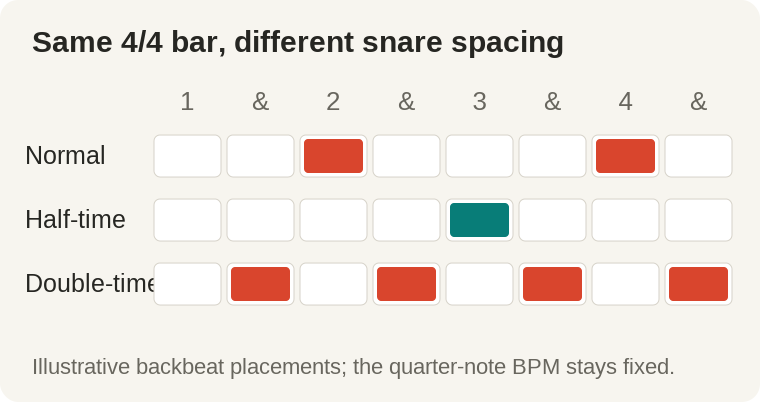
Listen to the spacing between backbeats while continuing to count the same quarter notes.
Start with one clock
Set a quarter-note pulse of 100 BPM and count “1 & 2 & 3 & 4 &.” Keep the numbered counts evenly spaced while changing the drum part. A bar still has four quarter-note beats and lasts 2.4 seconds in each version.
Beat and rhythm are useful separate ideas here: your beat reference stays fixed while the rhythmic pattern changes. A Music Theory Online analysis discusses how half-time and double-time relationships depend on comparison with an established or prevailing drum feel.
Space the backbeats farther apart
Begin with snare hits on 2 and 4. In the half-time exercise, replace those with one stronger snare on beat 3. Across repeated bars, the main snare arrivals are now four quarter-note beats apart instead of two.
The kick and hi-hat can support that larger spacing, but they need not become silent or slow. A half-time groove may still have quick hat notes. What matters is how the main accents and other parts establish the perceived rhythmic level, rather than the total number of hits alone.
Try the snare change first, then decide what the kick should do. Avoid moving every part at once if you are trying to hear the effect of the backbeat.
Bring the pattern to a faster level
For our double-time example, play kick on the numbers and snare on each &. There are four snare arrivals per original 4/4 bar instead of two. You can add sixteenth-note hats, but faster hats alone do not guarantee a double-time feel.
The complete arrangement affects the result. A busy cymbal part above a widely spaced snare can still read as half-time. The illustration isolates snare positions so you can compare one rhythmic feature directly; it leaves the choice of supporting parts open.
Changing BPM is a different operation
If you halve the BPM while leaving note positions and durations in beats unchanged, the whole performance takes twice as long. Doubling the BPM makes it take half as long. A MIDI or score renderer can change that timing without changing the written pitches. Audio time-stretching and resampling are separate processes with their own behavior.
Changing the displayed tempo interpretation from 70 to 140 can instead relabel related pulse levels if the note placement is adjusted to preserve the same sound. Always state the beat unit and what should stay fixed. Two tracks having a 2:1 tempo relationship does not by itself guarantee that their phrasing or other musical parts will mix well.
What about cut time?
Cut time, or 2/2, normally groups a bar as two half-note beats. It is a meter and beat-unit notation, not a universal instruction to perform a passage faster or slower. There is no general sheet-music rule that reverses the meanings of half-time and double-time. Read the specific tempo indication and musical context. See bars and time signatures for the grouping distinction.
Compare three Soundroo versions
Use the Soundroo prompt or connect your chat app. Ask for three eight-bar drum exercises at a quarter-note tempo of 100 BPM: normal backbeat on 2 and 4, half-time snare on 3, and the double-time kick/snare alternation described above. Keep the chord-change positions fixed if you add harmony. Count the same four numbered beats through each preview and compare how the groove is organized.