Verse vs. Chorus: Two Song Sections with Different Jobs
Published November 12, 2026
In a common verse–chorus song, verses develop details while the chorus returns to a central idea. Verse lyrics often change between appearances over recognizable musical material. A chorus usually brings back a recognizable melody and lyric, though writers can vary both.
The distinction is about each section's role in the song. Loudness, pitch range and length can help create contrast, but a verse can be energetic and a chorus can become quieter or sparser. Start by following what changes and what returns.
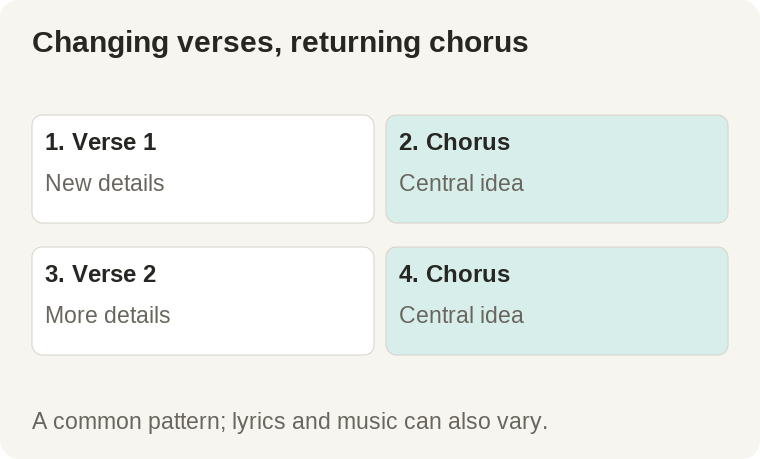
The repeated chorus gives a reference point while the verses move the story forward.
Follow the verse through new details
A verse can introduce a scene, develop a character or add another part of an argument. Its musical shape gives listeners something familiar while the words move forward. Verse 2 need not copy every rhythmic or melodic detail of verse 1.
For a simple story plan, verse 1 could describe leaving a hometown, and verse 2 the experience of arriving somewhere new. Both lead toward a returning chorus about the wish to find a sense of home. These are original planning ideas rather than finished lyrics.
Open Music Theory's pop and rock terminology distinguishes material that changes its words between appearances from material that preserves them. That is a useful clue, considered alongside the musical form.
Notice what the chorus brings back
A chorus often concentrates the song's central statement and contains a hook, but a hook can also appear in another section or an instrumental riff. Repetition alone does not make every short idea a chorus.
The returning melody, lyric or instrumental idea gives the listener a point of recognition. A writer can change the accompaniment, add a harmony part or alter a final line while preserving that identity. Listen for the section as a whole, rather than treating one repeated word as the definition.
Choose a form of contrast
Compare the melody, harmony, rhythm, register, instrumentation and density of the two sections. You might keep the same chords but introduce a new chorus melody, or keep the melody's register while changing its rhythmic shape.
A higher melody or a larger instrumental stack is one option. A drop to fewer instruments can also distinguish a chorus from a dense verse. Open Music Theory's formal-function discussion describes how sections contribute to a larger musical cycle.
| Listen for | A possible verse choice | A possible chorus choice |
|---|---|---|
| Words | New details each time | Returning central statement |
| Melody | Recognizable verse idea | Recognizable chorus idea |
| Arrangement | One instrumental texture | A contrasting texture |
The table offers choices to compare, not requirements for every song.
Arrange the sections over time
The illustration uses verse 1, chorus, verse 2, chorus. A longer arrangement might add an intro, a pre-chorus, a bridge or an outro. The number of repeats and the lengths depend on the piece.
Try a four-bar verse and four-bar chorus for an exercise, then extend either section if its idea needs more room. A bar is a timing group; it does not dictate how many lyric lines fit inside it. The broader song-structure guide maps those section roles.
Terminology can vary between styles and historical song forms. Here, the labels describe the modern verse–chorus relationship. Chorus versus refrain explains another common vocabulary overlap.
Try an instrumental comparison in Soundroo
Use the Soundroo prompt or connect your chat app. Ask for a sixteen-bar instrumental with four-bar verse, chorus, verse and chorus sections. Give the verses a varied piano idea and the choruses a returning lead motif, with the tempo held fixed. Ask for an arrangement contrast you can identify, such as a new bass rhythm or a sparser texture. Soundroo renders instrumental parts, so the exercise explores the section roles through notes and arrangement rather than sung lyrics.