What Is a Polyrhythm? Count Three Against Two
Published November 12, 2026
A 3:2 polyrhythm places three evenly spaced notes against two evenly spaced notes within the same span of time. Both layers begin together. Between those shared starts, the layers divide the cycle differently.
A useful way to learn it is to divide one complete cycle into six equal subdivisions. The three-note layer plays on subdivision 1, 3 and 5. The two-note layer plays on 1 and 4. Repeat those six slots evenly; both layers meet again on the next cycle's 1.
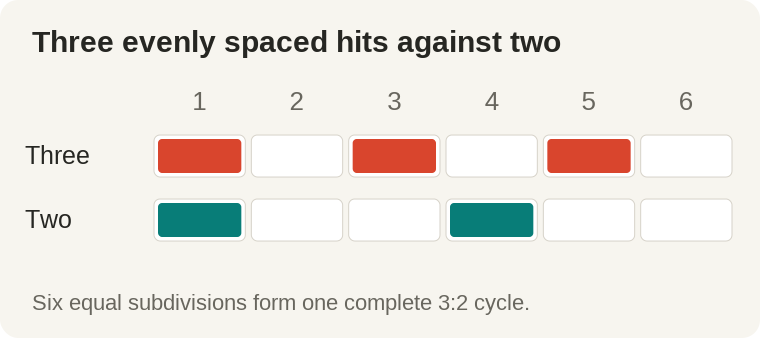
Both parts start together and meet again at the beginning of the next cycle.
Build a shared counting grid
Six is the smallest positive whole number divisible by both three and two. That is why a six-slot grid can place every hit of this example exactly. One layer has a hit every two slots; the other every three slots. Do not speed up the slots to squeeze the second layer in.
| Subdivision | 1 | 2 | 3 | 4 | 5 | 6 |
|---|---|---|---|---|---|---|
| Three-note layer | Hit | — | Hit | — | Hit | — |
| Two-note layer | Hit | — | — | Hit | — | — |
First tap the two-note layer by itself. Then tap the three-note layer by itself over a cycle of the same duration. Once each is steady, use separate hands or two different sounds to combine them. Baylor University's Rhythm and Meter Compendium provides further exercises in two-against-three and three-against-two relationships.
The numbers 1 through 6 in our chart name equal subdivisions, not necessarily six main beats or a 6/8 time signature. Keep the distinction between beat and rhythm clear as you practice.
Hear the combined pattern
The first hit sounds in both layers. Next comes the second hit of the three-note layer, then the second hit of the two-note layer, then the third hit of the three-note layer. The next shared hit begins a new cycle. There are spaces between those events, so do not play the combined arrivals as four evenly spaced hits.
You can stretch the entire cycle to a comfortable length. The ratio stays 3:2 as long as each layer keeps its equal spacing and both occupy the same total span. Naming it 2:3 can change which layer you treat as the reference; be explicit about the reference when giving instructions.
Is any pair of rhythms a polyrhythm?
Musicians use the word in somewhat different ways. Here it means contrasting simultaneous divisions such as three against two or four against three. Quarter notes against ordinary eighth notes are usually described as different subdivision levels of the same pulse, rather than the kind of cross-rhythm we are practicing.
Syncopation concerns emphasis against an expected beat pattern. It does not by itself require two contrasting equal divisions. A rhythm can be syncopated without being a 3:2 polyrhythm, and a polyrhythm can also contain accents that create syncopation.
Polymeter concerns simultaneous metrical groupings, such as repeating three-beat and four-beat bars over a shared beat unit. The labels address different aspects of timing and can overlap in analysis. Whether two parts meet at a printed barline is not a complete definition of either term.
Make the two layers easy to hear
Use distinct sounds, such as a low drum and a higher percussion sound. Keep the volumes balanced enough to hear both. Start with a short repeating cycle and no extra rhythmic decoration. Then remove one layer temporarily and check that you can continue the other without changing its spacing.
In Soundroo, use the prompt or connect your chat app. Ask for eight two-beat cycles at a quarter-note tempo of 90 BPM. In each cycle, one part plays at beat offsets 0, ⅔ and 1⅓; the other at 0 and 1. Eight cycles occupy sixteen quarter-note beats: four bars of 4/4. Ask for each part alone, then together, and follow the six-slot diagram while listening.