Ostinato, Riff and Motif: Three Ways Music Uses Repetition
Published November 12, 2026
An ostinato is a pattern that keeps repeating. A riff is a short, recognizable musical phrase, often repeated as part of a song’s identity. A motif, also spelled motive, is a small musical idea that can return and develop. These terms describe different aspects of an idea, so the same notes can qualify as more than one.
Try singing a short phrase twice. You have already made repetition. What you do with that phrase next helps determine which description is useful.
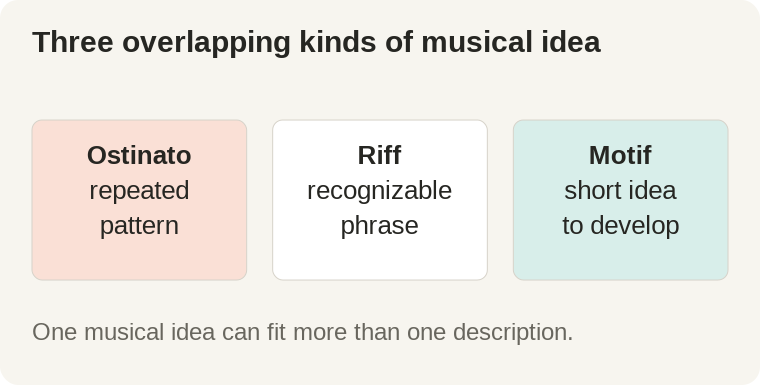
These describe different aspects of an idea; they are not mutually exclusive boxes.
Ostinato: listen for the repeating pattern
An ostinato can repeat pitches, a rhythm, or both. It might be a bass figure beneath changing chords, a percussion pattern, or a conspicuous melody. The Open University’s introduction to musical loops explains the relationship between persistent repetition and ostinatos.
Here is an original one-bar exercise in 4/4. Play four quarter notes: C–E–G–E. Each note lasts one beat. Repeat that bar four times without changing its notes or rhythm. That repeating line is an ostinato in this exercise.
Keep it running while another part plays longer notes above it. The repeated line supplies continuity while the other part changes. It can be soft or prominent; being in the background is not part of the definition.
Riff: recognize a recurring phrase
A riff is a compact phrase that listeners can recognize when it comes back. It may belong to a guitar, bass, keyboard, horn section or another instrument. Columbia University’s jazz glossary describes riffs as short repeated melodic phrases with a rhythmic function.
Give the C–E–G–E idea a distinctive rhythm. Play C on beat 1, E on the “and” after 1, G on beat 2, and E on beat 3. Leave beat 4 empty. The durations can be an eighth note, an eighth note, a quarter note, and a quarter note, followed by a quarter rest. That fills exactly one 4/4 bar.
Repeat this as the recognizable phrase of your track. It can serve as a riff and, if it persists through a passage, as an ostinato. A riff does not need a prescribed number of bars.
Motif: develop a small idea
A motif is a small identifiable musical idea. It may be recognized through pitch shape, rhythm or both. University of Puget Sound’s theory text introduces motives as building blocks for larger melodies.
Take just C–E–G from our exercise. Then make a related answer:
- Move the shape upward to D–F–A, keeping the same rhythm. This preserves the pattern of rising by thirds within C major, while changing the exact interval sizes.
- Keep C–E–G but give the last note a longer duration.
- Use only C–E as a shorter fragment, then pause before answering it.
These are ways to develop material while preserving something recognizable. You can use a motif in a short phrase; it need not appear throughout an entire composition.
Choose what the repetition should do
For continuity, keep an ostinato stable while changing surrounding parts. For a memorable instrumental feature, shape a riff with a clear rhythm and some breathing room. To build a longer melody, vary a motif and listen for a relationship between each version.
In Soundroo, ask your agent for four bars built around the C–E–G–E quarter-note ostinato. Then request four more bars that develop the C–E–G motif while the bass changes. Listen for what repeats and what changes. If every part changes at once, ask the agent to keep one pattern steady so the relationship is easier to hear.