What Is a Pickup in Music? Count Notes Before the First Full Bar
Published November 12, 2026
A pickup, also called an anacrusis, is a note or group of notes leading into the first full downbeat of a phrase. At the beginning of a score, it is often written as an incomplete first measure. The melody starts before the full bar begins, rather than directly on beat 1.
For a one-quarter-note pickup into 4/4, count “4, 1, 2, 3, 4.” The first 4 belongs to the lead-in; the following 1 begins the first complete bar. The pickup does not make that complete bar five beats long.
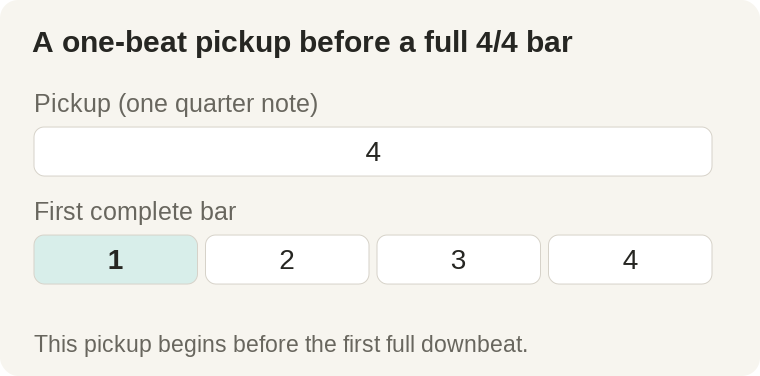
This is one possible pickup length. Pickups can contain other note values and durations.
Count backward from the first full downbeat
Find the first complete measure and its beat 1. Then work out how much time the pickup occupies immediately before it. If there is one quarter note before that downbeat in 4/4, it starts on 4. Two quarter notes start on 3. A single eighth-note pickup can begin on the & of 4.
A pickup need not contain a whole number of main beats. Its duration can be a short subdivision or a longer lead-in, as long as you place the following downbeat correctly. The MuseScore Studio handbook describes pickup measures as partial measures at the start of a score or section.
| Pickup duration before a 4/4 bar | Start counting at |
|---|---|
| One eighth note | & of 4 |
| One quarter note | 4 |
| Two quarter notes | 3 |
| Three quarter notes | 2 |
The note values still have their ordinary relative lengths. If you need help with those, see note values and rests.
The written first measure can be shorter
Notation often leaves out the empty part before an opening pickup. Instead of writing three beats of rests followed by one quarter note, the score can begin with just that quarter note in an incomplete measure. The following full measure keeps the prevailing time signature.
That is a notation choice about how to present the beginning. It does not mean every line of the printed score needs another short measure. A new staff line is a page layout decision, not a new musical phrase or a reason to remove beats.
Does the ending have to balance the pickup?
Some pieces balance an opening pickup with a shortened final measure. In 4/4, a one-beat opening can pair with a three-beat ending, particularly where a repeat joins the end back to the beginning. You will also encounter pieces and arrangements with other endings.
Do not assume a universal debt of “borrowed” beats that every composer must repay. Read the actual ending and repeat instructions. The bar guide explains how complete measures and their boundaries work.
Pickups can occur within a song
A melody can lead into a later verse or chorus before that section's main downbeat. The accompanying instruments may already be playing full measures underneath it. In that case, the pickup notes occupy part of the existing bar; the band does not need to insert an extra partial bar.
When rehearsing, agree where the first full bar is and how you count the lead-in. Measure-numbering conventions can exclude an opening incomplete measure, but follow the numbering in the score you are using.
Try a lead-in with Soundroo
Use the Soundroo prompt or connect your chat app. Ask for a 4/4 piano phrase at 90 BPM that begins with a single lead-in note on beat 4, followed by a melody starting on the next beat 1. For easy counting, ask for three silent quarter-note beats before that first piano note. Compare it with a version that starts directly on 1. Keep the melody after that downbeat the same, so you can hear what the pickup changes.