Dynamics in Music: Shape Loudness, Accents and Musical Energy
Published November 12, 2026
Dynamics describe how softly or loudly music is performed and how that changes through a passage. A quiet opening, a gradual rise and a sudden drop can give the same notes a different shape.
Dynamics are relative to the instrument, performance and surrounding music. A marking such as forte asks for a loud character in context; it does not specify one universal decibel reading.
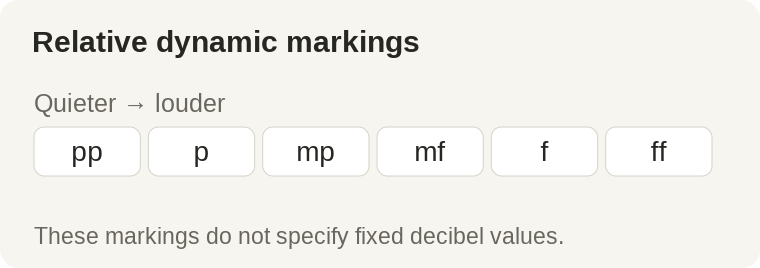
Dynamics depend on the instrument, performer and surrounding music.
Recognize the common markings
Western staff notation often uses abbreviated Italian terms. The Open University’s performance-direction list includes the common dynamic and articulation instructions.
| Marking | Term | Basic direction |
|---|---|---|
| pp | Pianissimo | Very soft |
| p | Piano | Soft |
| mp | Mezzo piano | Moderately soft |
| mf | Mezzo forte | Moderately loud |
| f | Forte | Loud |
| ff | Fortissimo | Very loud |
The diagram orders these from relatively softer to louder. They are not equally spaced numerical steps. A piano passage still needs a clear sound and shape; playing softly does not mean making every note disappear.
Gradual changes and sudden contrasts
A crescendo means gradually getting louder. A decrescendo or diminuendo means gradually getting softer. Hairpin symbols can show these directions: an opening wedge indicates a crescendo, while a closing wedge indicates a decrescendo.
A new dynamic marking can ask for a more immediate change. For example, a forte phrase followed by piano creates a sudden contrast. Decide where the change belongs and how it relates to the phrase rather than adding a volume ramp at random.
Tempo is a separate choice. Getting louder does not require speeding up, and getting softer does not require slowing down. Try keeping the pulse steady while changing only the dynamic shape.
Accents emphasize particular events
An accent draws attention to an individual note or chord. A common accent mark is a short wedge above or below a note. The precise performance depends on the instrument and musical style, but it generally asks for emphasis within the phrase.
An accent and a crescendo operate at different scales: one event can stand out inside a generally soft phrase, while a whole phrase can gradually grow. Duration and tone can also contribute to perceived emphasis. Staccato, which asks for separated notes, is not simply another word for loud.
Use accents to make a rhythmic idea clearer. Emphasizing an offbeat can contribute to syncopation, especially when it challenges the expected accent pattern.
Shape a four-bar phrase
Here is an original exercise in 4/4. Repeat C–E–G–E as four quarter notes in each bar. Begin softly in bar 1, grow through bars 2 and 3, then return to a soft level in bar 4. Keep the note lengths and tempo steady.
Next, keep the overall level fairly even but emphasize the first note of each bar. Compare the local accents with the longer dynamic arc. You are changing different features of the same phrase.
Make the comparison in Soundroo
In Soundroo, ask your agent for the four-bar piano exercise with changing note velocities, then a version with more even velocities. Soundroo notes have a velocity control; how strongly it changes the sound depends on the instrument.
Keep both shapes in one comparison track if you want to hear their relative levels. Soundroo applies mastering to renders, so making two separate tracks globally louder or softer may be partly offset by normalization. Changes within a phrase, instrumental balance and arrangement are better places to explore the musical effect.